The Diamond Model
What Determines Competitiveness?
- Macroeconomic competitiveness sets the economy-wide context for productivity to emerge, but is not sufficient to ensure productivity
- Endowments, including natural resources, geographical location, population, and land area, create a foundation for prosperity, but true prosperity arises from productivity in the use of endowments
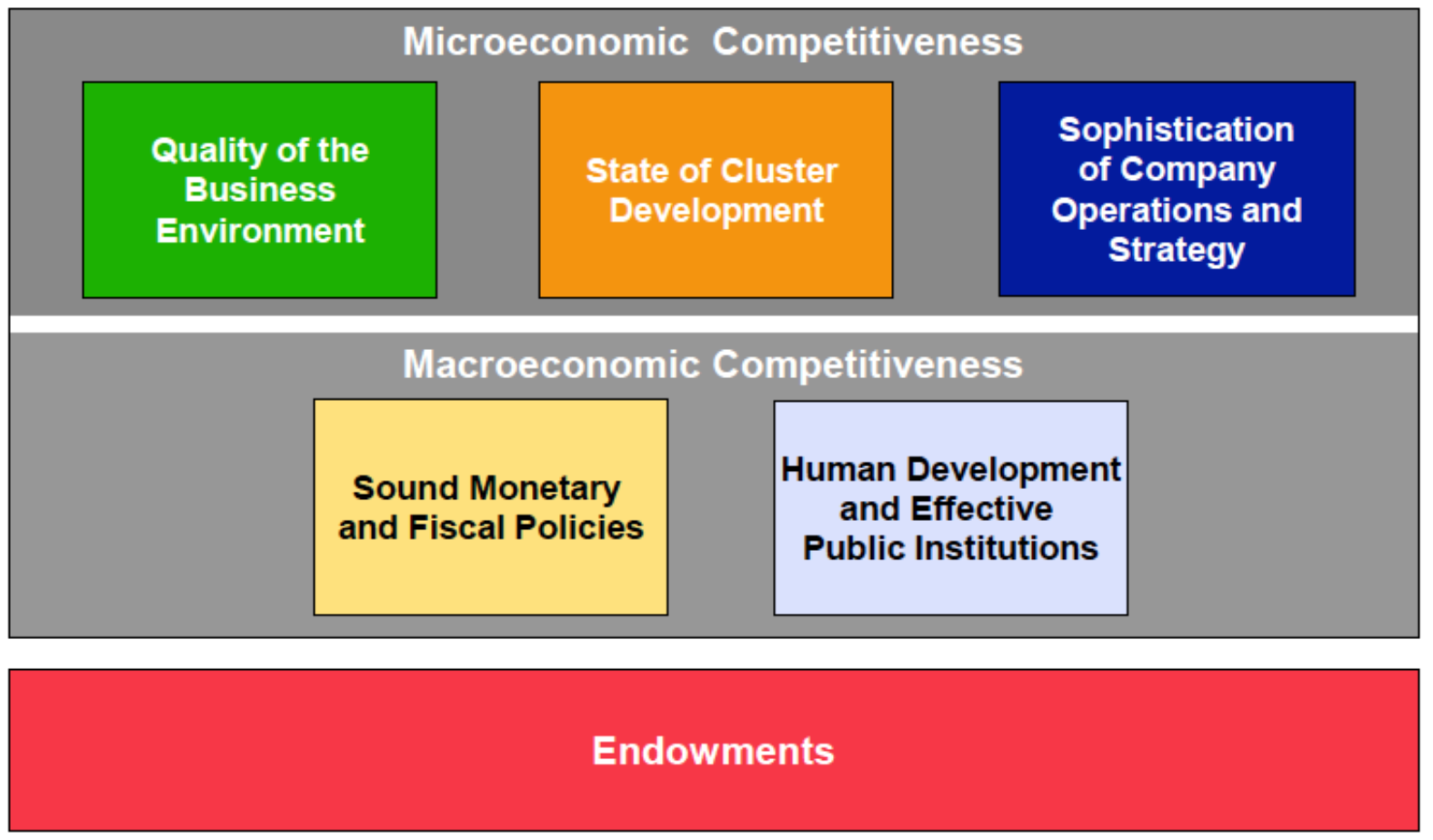
- Productivity ultimately depends on improving the microeconomic capability of the economy and the sophistication of local competition revealed at the level of firms, clusters, and regions
- Macroeconomic competitiveness sets the economy-wide context for productivity to emerge, but is not sufficient to ensure productivity
- Endowments, including natural resources, geographical location, population, and land area, create a foundation for prosperity, but true prosperity arises from productivity in the use of endowments
- Competitiveness is determined by the productivity with which a nation, region, or cluster uses its human, capital, and natural resources.
- Productivity sets a nation’s or region’s standard of living (wages, returns on capital, returns on natural resources)
- Productivity depends both on the value of products and services (e.g., uniqueness, quality) as well as the efficiency with which they are produced
- It is not what industries a nation or region competes in that matters for prosperity, but how firms compete in those industries
- Productivity in a nation or region is a reflection of what both domestic and foreign firms choose to do in that location. The location of ownership is secondary for national prosperity
- The productivity of “local” industries is of fundamental importance to competitiveness, not just that of traded industries
- Devaluation does not make a country more “competitive”
- Nations or regions compete in offering the most productive environment for business
- The public and private sectors play different but interrelated roles in creating a productive economy
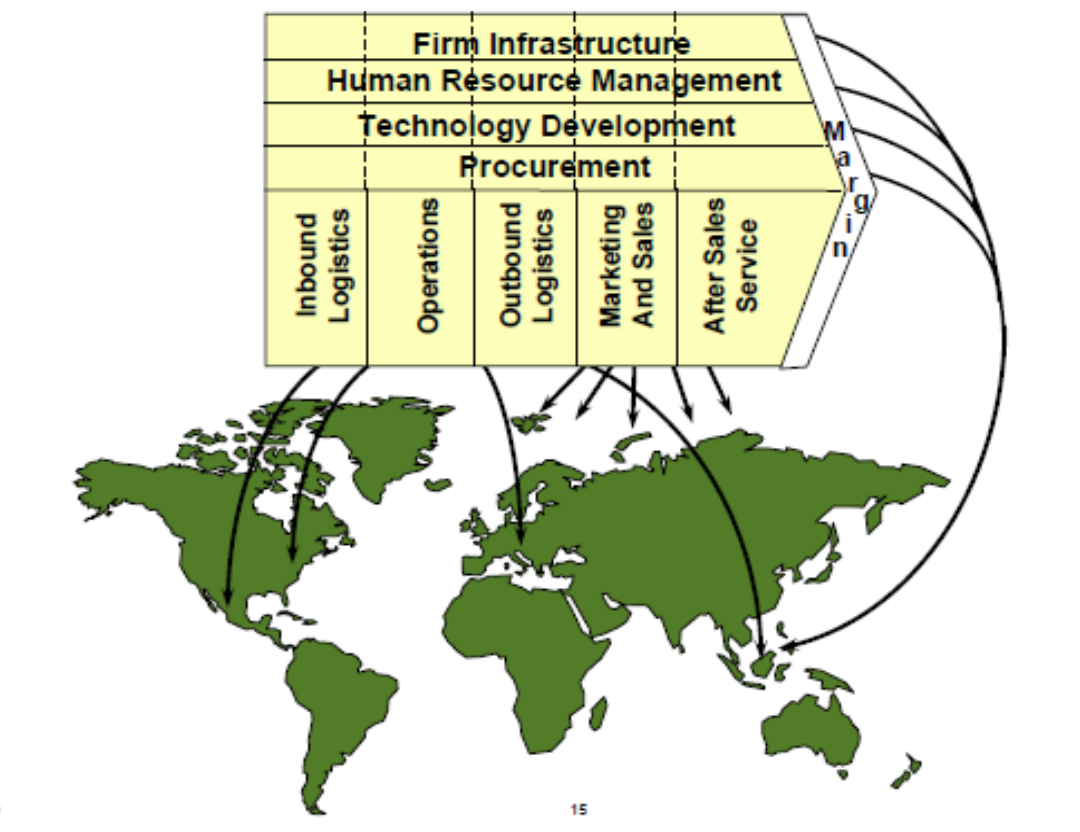
Competing Regionally and Globally
- Selling in many nations
- Locating activities in different nations
- Coordinating a regional or global network
Determinants of Productivity and Productivity Growth
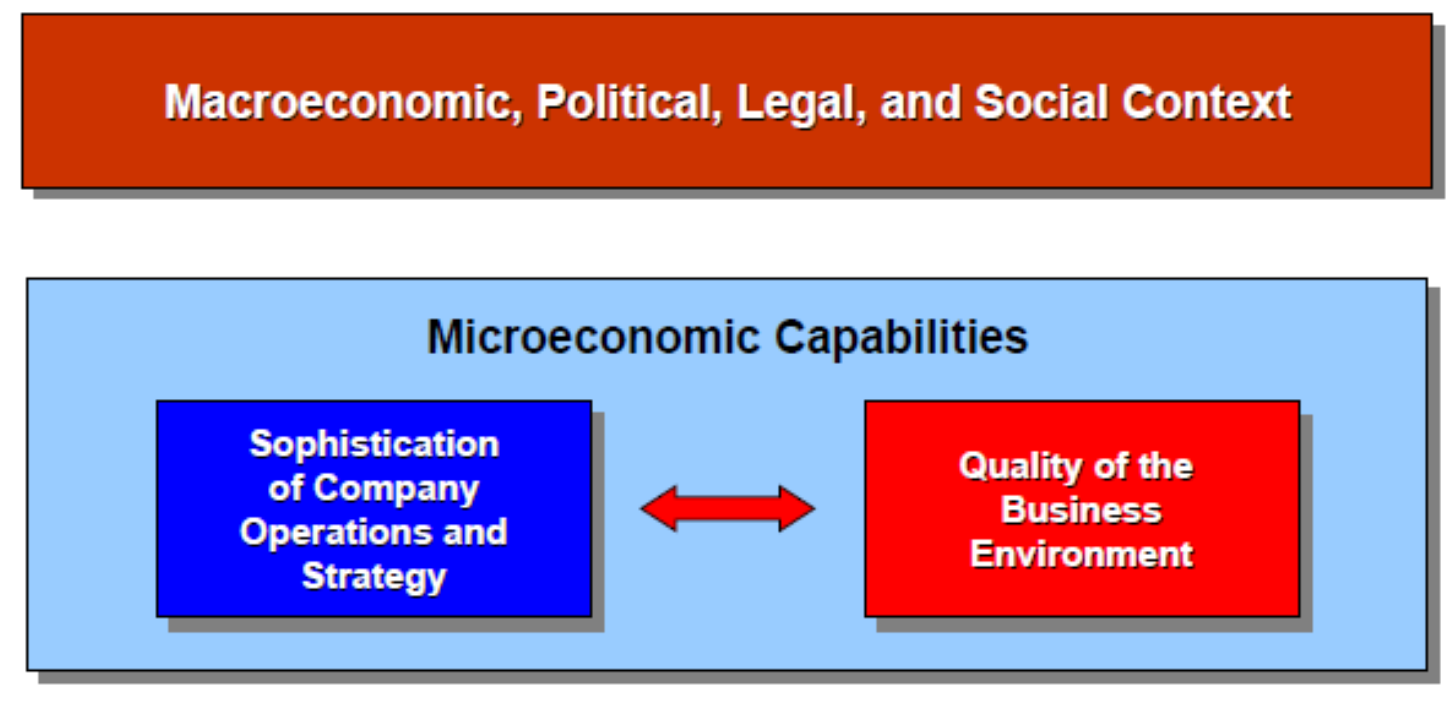
- A sound context creates the potential for competitiveness, but is not sufficient
- Competitiveness ultimately depends on improving the microeconomic capability of the economy and the sophistication of local companies and local competition
Conditions for Competitiveness
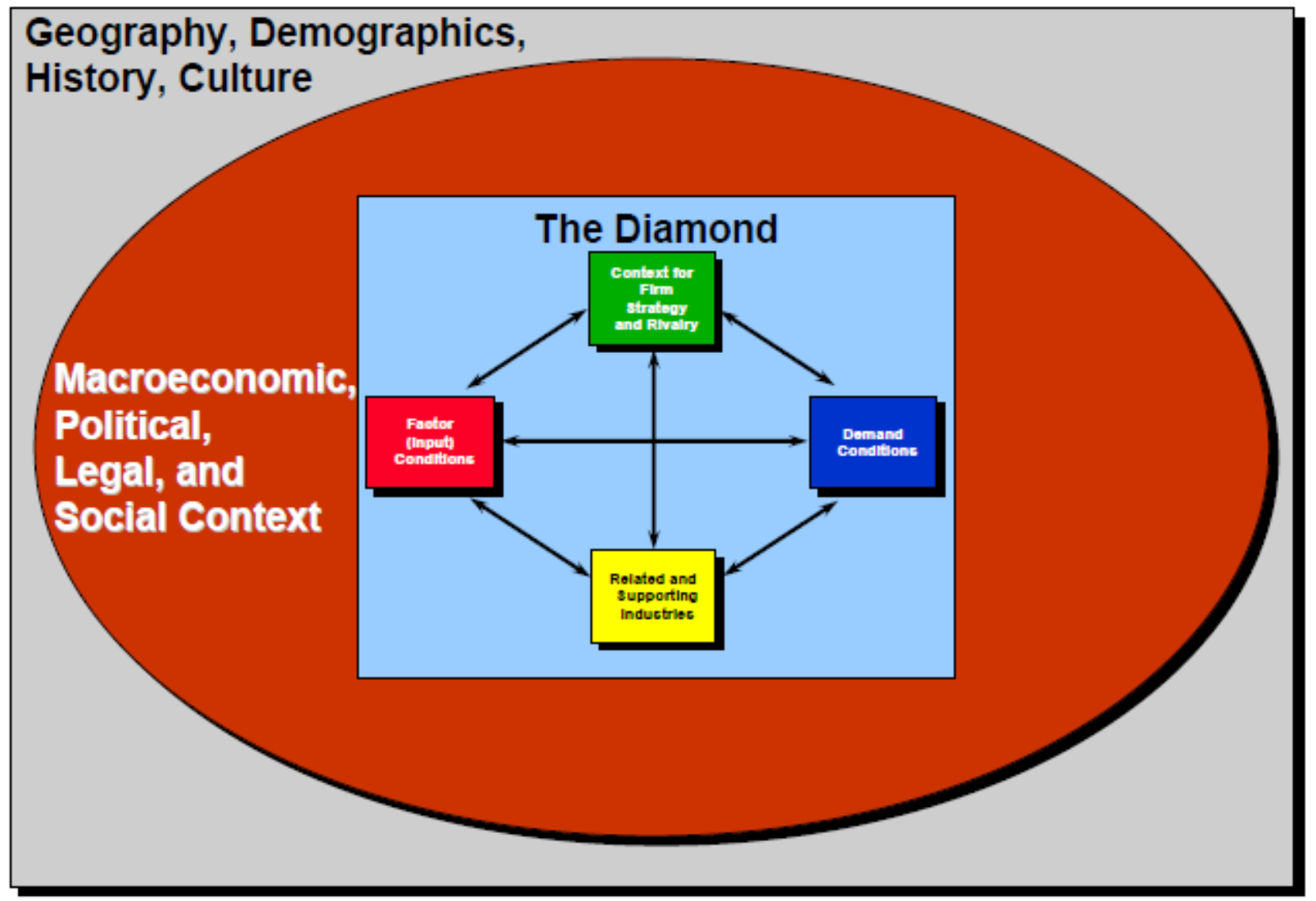
Quality of the Business Environment: The Diamond
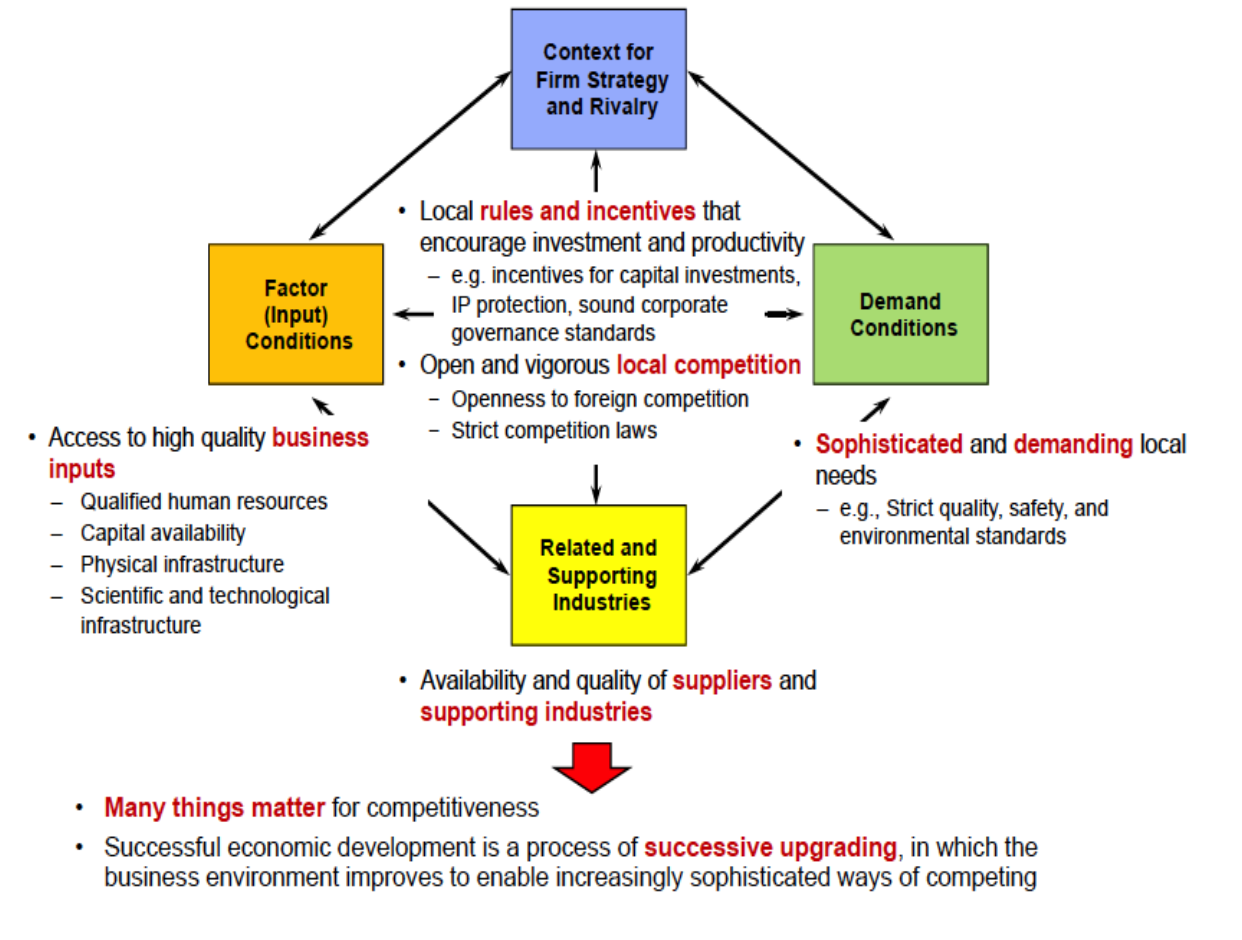
Common Issues in Diamond Analysis
- Categorizing influences in the diamond
- Separating performance indicators (outcomes) and diamond dimensions
- Levels of influence on the diamond
- National / state / metropolitan area
- General vs. cluster specific
- Arrows in the diamond
- Separating cause and effect
- Identifying the constraints in a country or a cluster
- Short-term
- Longer-term
Building the Diamond
Factor (Input) Conditions
| Typical Starting Point for Developing Countries |
| High reliance on the availability of low wage, unskilled labor and natural resources Lack of capital Low savings Capital flight Inefficient public administration and regulatory processes which are subject to corruption Underdeveloped infrastructure, capital markets, and educational Most technology is externally supplied and controlled Low productivity |
| Successful Economic Development |
| Create functioning administrative infrastructure for registration and regulation Expand business-related information Upgrade the quality and efficiency of existing factor inputs Natural resource pricing and conservation Quality and reach of public education Physical infrastructure efficiency Efficiency of labor markets Depth of financial markets Widen the array of locally available factor inputs Improve factor specialization Build scientific and research institutions and the capacity to assimilate foreign technology |
Context for Firm Strategy and Rivalry
| Typical Starting Point for Developing Countries |
| High capital costs and short time horizons Opportunistic practices by firms Competition blunted by monopoly concessions, state-owned companies, corruption, and heavy government intervention Companies protected from foreign competitors Monopolistic companies are dominant or cartelize the market Any local rivalry occurs largely on price |
| Successful Economic Development |
| Reduce internal governmental impediments to competition End monopoly government licenses and concessions Phase out government price controls, entry controls, and locational restrictions Open state monopolies to competition Improve governance of SOEs and government-linked companies Privatize SOEs Begin an irreversible process of opening the economy to foreign competition, including FDI Create and implement an effective competition policy Develop an effective legal structure and enforcement mechanisms for intellectual property Reduce investment hurdle rates and lengthen time horizons Move beyond price cutting and product imitation to specialization and differentiation |
Demand Conditions
| Typical Starting Point for Developing Countries |
| Unsophisticated local demand Low average income levels Little information Limited selection Overwhelming focus on price Product and service designs are imitated or licensed from abroad Lax product, health, safety and environmental standards The home market distracts attention from developing internationally competitive products |
| Successful Economic Development |
| Improve local demand quality: Expand buyer information and increase consumer protection against poor-quality products Open the market to foreign products Phase out restrictions and tax biases against sophisticated products Raise product, safety, health, energy and environmental standards towards international levels Use government procurement to stimulate the supply of higher quality products Facilitate exports to neighboring countries or other countries where needs are similar Set policies that foster early demand for more advanced products |
| Typical Starting Point for Developing Countries |
| Local suppliers are scarce and uncompetitive Most sophisticated machinery, components, and more advanced equipment and services must be imported Inefficient vertical integration reflects the lack of local suppliers and barriers to imported inputs Early export successes often occur in industries with weak inter-industry linkages |
| Successful Economic Development |
| Open market access to foreign suppliers of sophisticated components, machinery, and services Seek FDI that attracts world-class suppliers to support and deepen emerging local clusters Establish programs to support improvements in the local supplier base |
Measuring Competitiveness
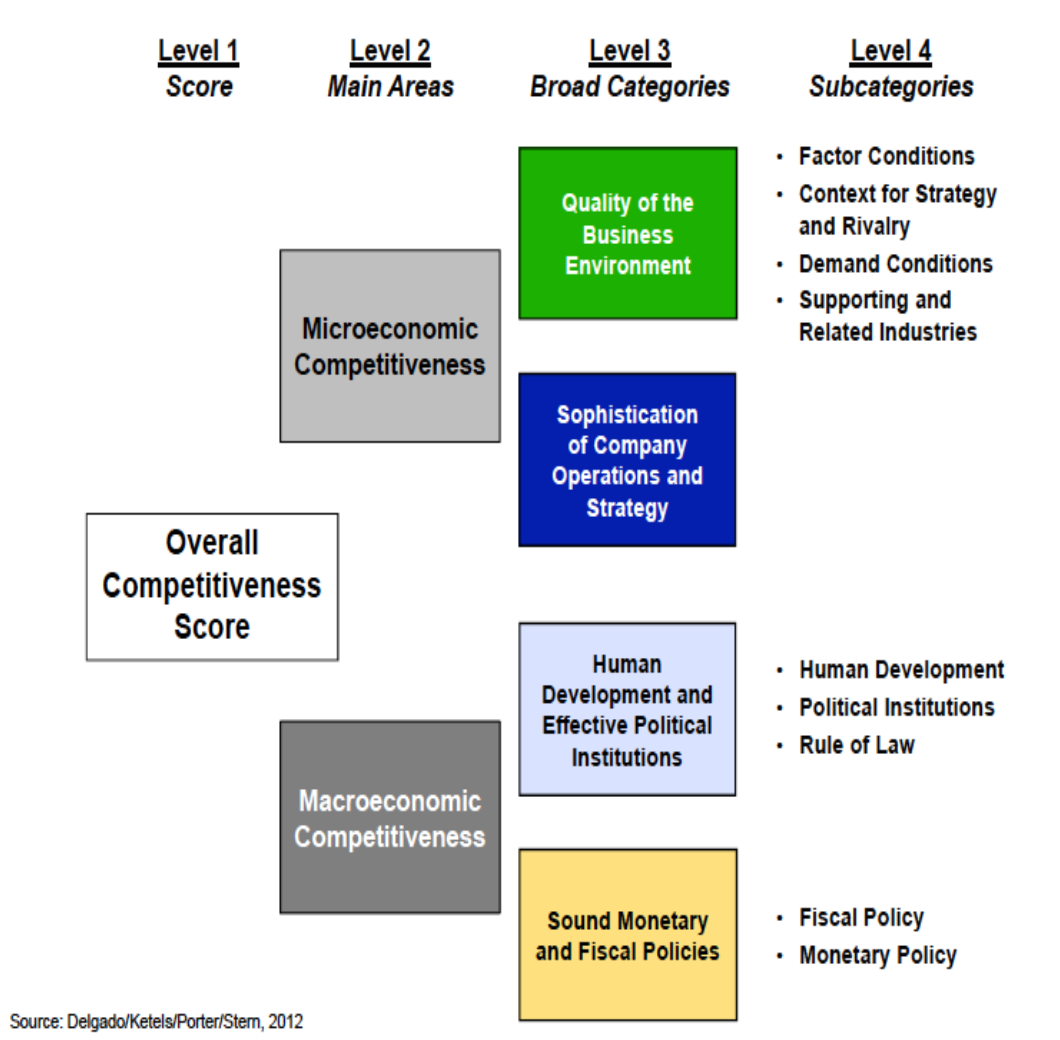
National Competitiveness
| Components | |
“Macro”
| Geographic Levels
|
Macroeconomic Competitiveness
| Social Infrastructure and Political Institutions | Macroeconomic Policies |
Basic human capacity
| Fiscal policy
|
The Process of Economic Development
Upgrading the Diamond
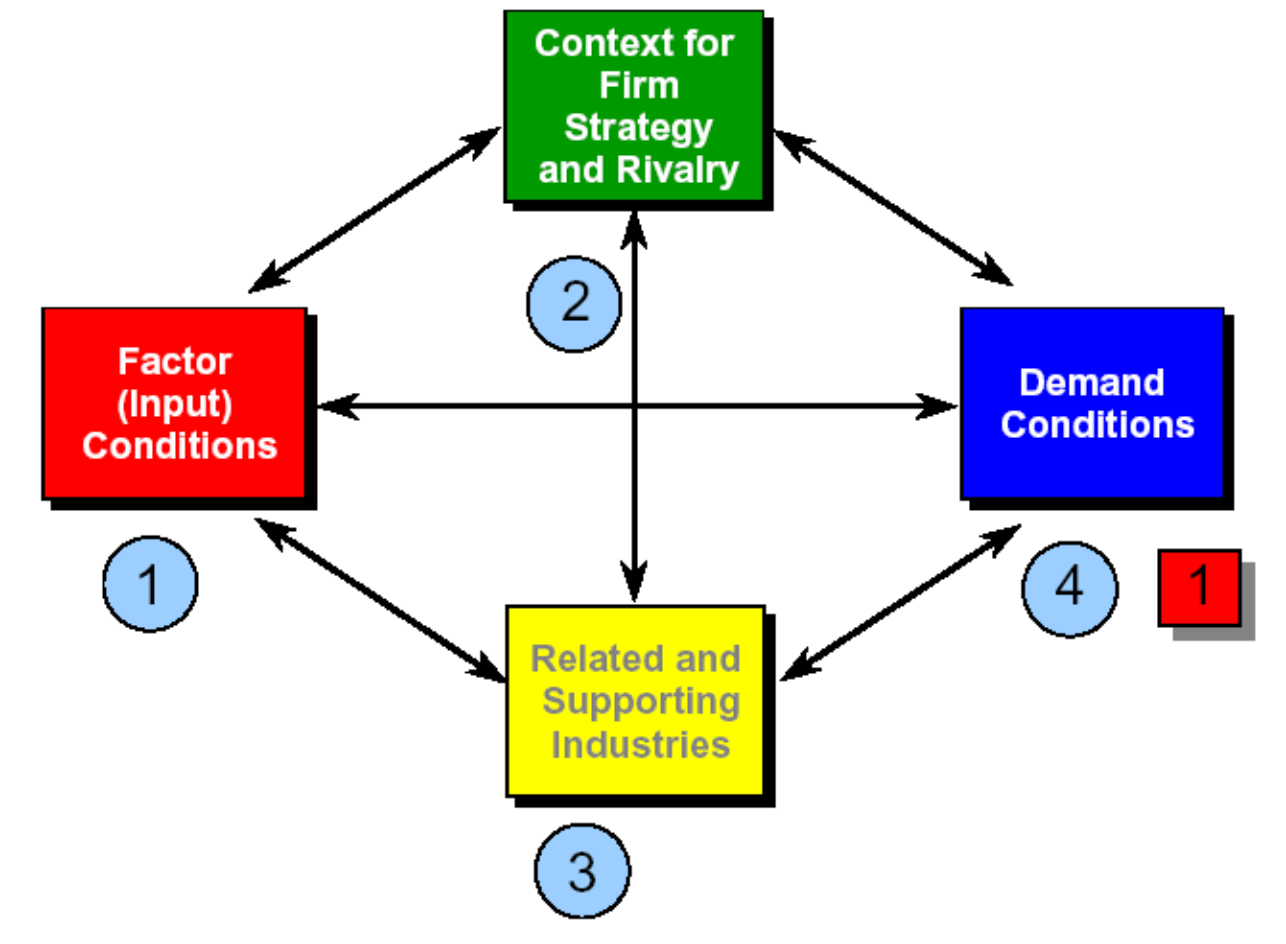
Stages of Competitive Development
| Factor-Driven Economy | Investment-Driven Economy | Innovation-Driven Economy |
| Low Cost Inputs | Efficiency through Heavy Domestic and Foreign Investment | Unique Value |
| Competitive Advantage | Competitive Advantage | Competitive Advantage |
| Low-cost basic factor conditions (low-skilled labor, natural resources, geographic location) Companies compete on price in the commodity markets or producing for others Companies have limited roles in the value chain, focus on assembly, labor intensive manufacturing, and resource extraction Technology is assimilated from others, FDI, and imitation The economy is highly sensitive to world economic cycles, commodity prices, and exchange rates | The ability to produce standard products and services of good quality using efficient methods but at lower wages than advanced economies The economy is concentrated on manufacturing and outsourced service exports Companies serve OEM customers and expand capabilities more widely in the value chain The national diamond supports heavy investment in efficient infrastructure and modern production processes Technology is accessed through licensing, joint ventures, FDI, and imitation, while local capacity to improve and develop technology is present | Innovative products and services at the global technology frontier Companies compete with distinctive strategies that are often global in scope The national diamond is characterized by strengths in all areas together with the presence of deep clusters The economy has a high service share and is resilient to external shocks |
Legacies of Planned Economies
| Creating a Productive Economic Structure | |
| Legacies of a Planned Economy | Cluster-based Economy |
| Economic policy is centrally directed Buyers/supplier linkages are managed from a national perspective Relationships between suppliers and buyers are specified and focused on production of defined goods and services The geographic locations of related economic activities driven by political and security | Economic policy involves significant autonomy and institutions at the regional and local level There is specialization of regions across the fields in which they compete Externalities across firms and institutions in clusters facilitate productivity and dynamism Geographic choices are based on the economic attractiveness of locations; firms co-locate with others |
Company Transformation and Economic Development
| Typical Strategies and Operating Practices in Developing Economies | ||
| Corporate Direction | Strategic Positioning | Value Chain |
| Opportunistic pursuit of new businesses, selling whatever opportunities in whatever area they arise Strategy driven by government and other relationships Conglomerate business groups compete in highly disparate businesses | Focus on the local market rather than regional and international markets Wide product lines serving local industry segments Price is the primary basis of competition Low product and service quality Companies imitate foreign best practices Imitation of products and services of leading domestic competitors | Labor intensive parts of the value chain Low investment in machinery, equipment, branding, R&D, and training Foreign partners provide many inputs, know-how, and financing |
Integretion of Macro and Microeconomic Reforms
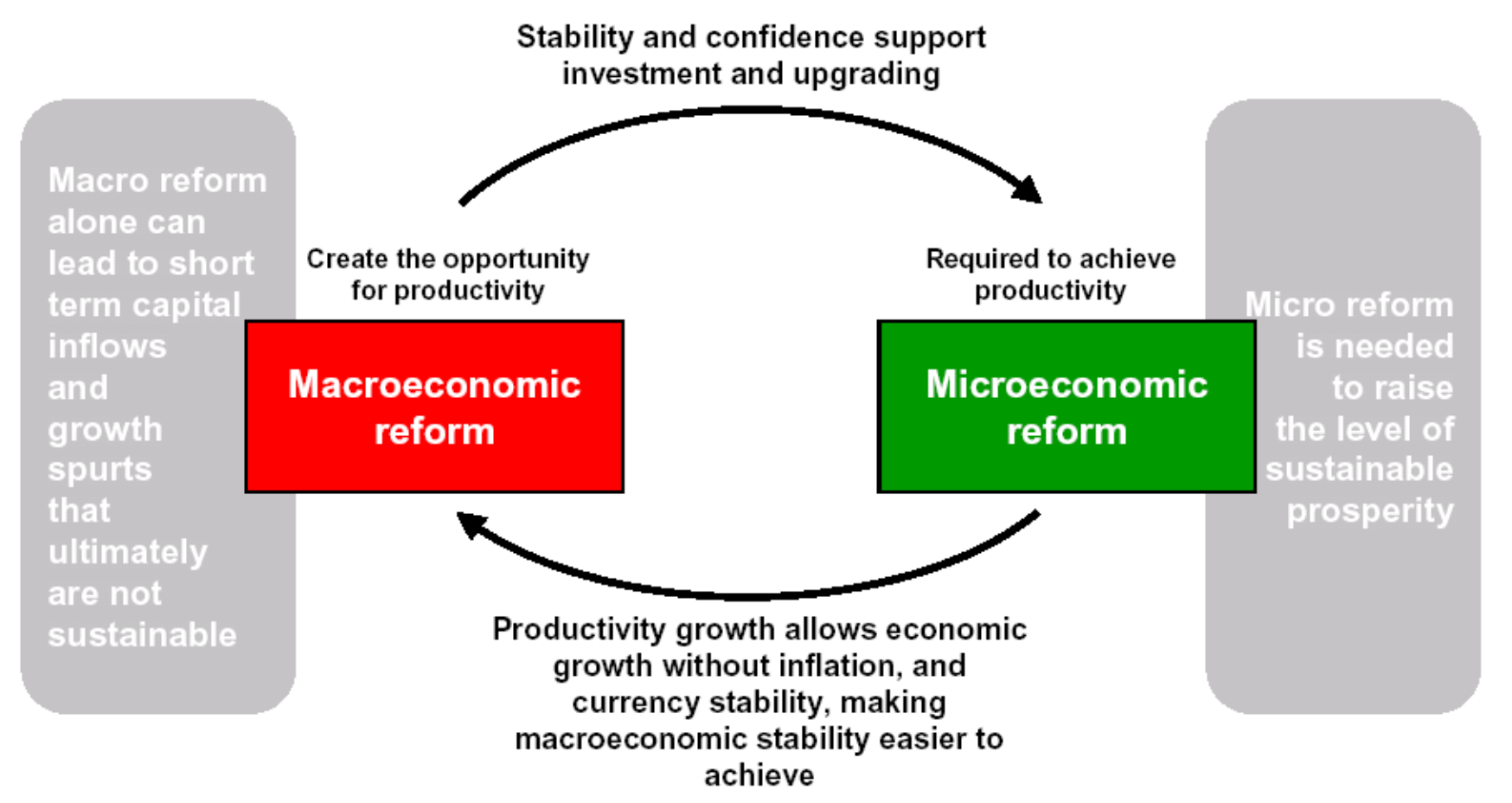
Examples
Training
- Organize training investments around clusters
Housing
- Create mechanisms to encourage home ownership; provide incentives for new company formation in the construction cluster; reduce unnecessary costs of housing construction due to regulatory and permitting delays; secure property rights to residents and property holders
Health Care
- Create incentives for private insurance; open health care delivery to competition
Social Security
- Establish a private pension system. Integrate welfare payments with training and incentives to return to the workforce
Environmental Quality
- Institute a regulatory regime that encourages movement to more environmentally friendly methods; invest in technical assistance in eco-efficient processes and practices
Summary
- The diamond framework applies to economies at all stages of economic development
- The specific conditions and action priorities differs dramatically across countries and stages of development
- Developing countries must raise the macroeconomic competitiveness to a minimum level to have a chance for sustained development
- Developing countries have weaknesses across many diamond dimensions
- Strategies that address only one element of the diamond are of limited effectiveness in producing growth and improving prosperity
- A focus on macroeconomic reform or trade liberalization alone is ultimately unsustainable if not supported by broader upgrading of the microeconomic fundamentals
- Towards reliance on microeconomic upgrading alone can be severely compromised by significant challenges in macroeconomic competitiveness
- Diamond improvements should be sequenced to address the constraints to productivity at each income and development level