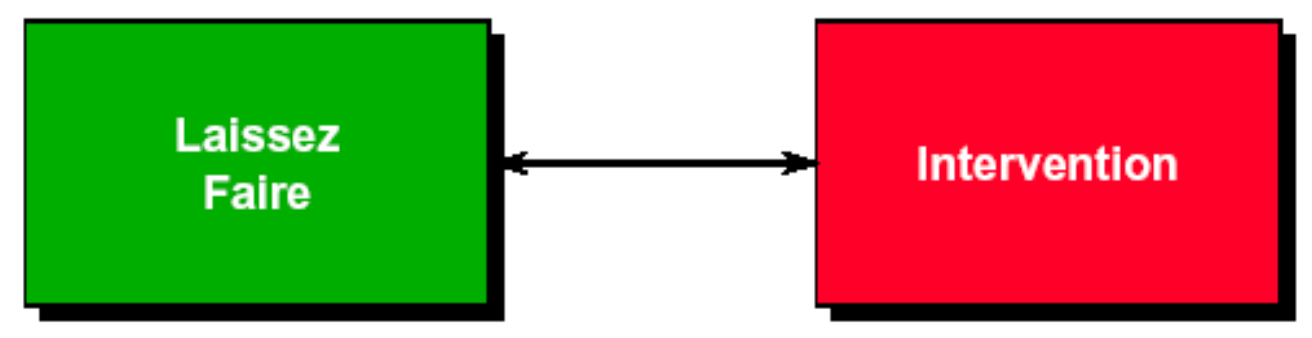
The role of Government
Debates Over Role of Government
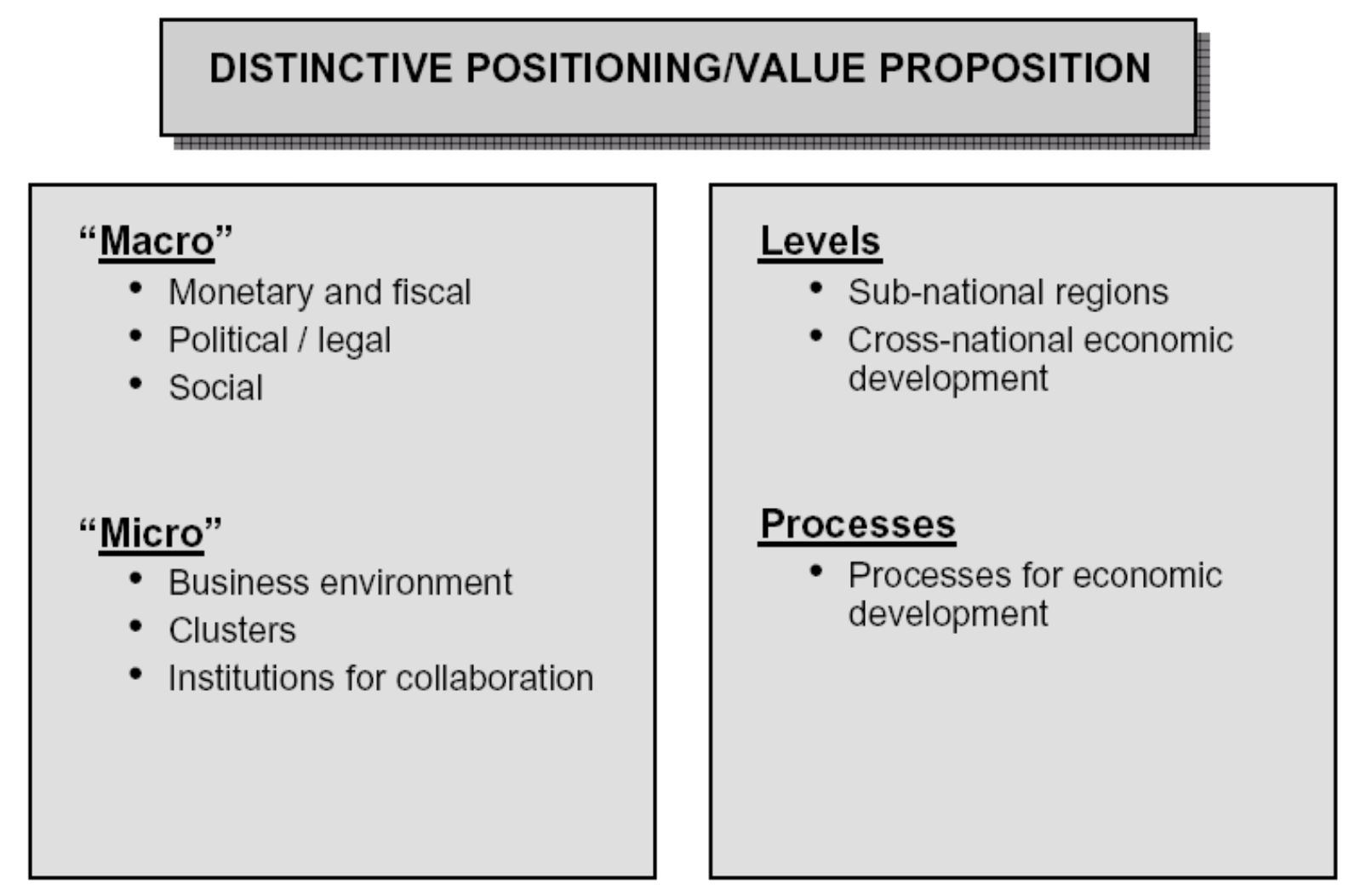
Define a distinctive position in the regional and global economy
- Determine a unique value proposition (what value? What set of economic activities?)
- That builds on strengths, not just reduces weaknesses
Upgrade the macroeconomic, political, legal, and social context
- Establish a stable, predictable, and trusted macroeconomic, legal, and political environment
- Improve the social conditions of citizens
Upgrade the general microeconomic business environment
- Improve the availability, quality, and efficiency of cross-cutting or general purpose inputs, infrastructure, and government services
- Set overall rules and incentives governing competition that encourage productivity growth
Build clusters
- Facilitate cluster development and upgrading
Enable a process of economic change
- Inform citizens about competitiveness and the imperatives of the global economy
- Create a governmental structure that facilitates the creation and implementation of economic strategy
- - An important role for subnational regions
- Establish a structure involving independent institutions in which government, the private sector, educational and other institutions, and civil society work together in competitiveness improvement
Government Policies and the Business Enviroment
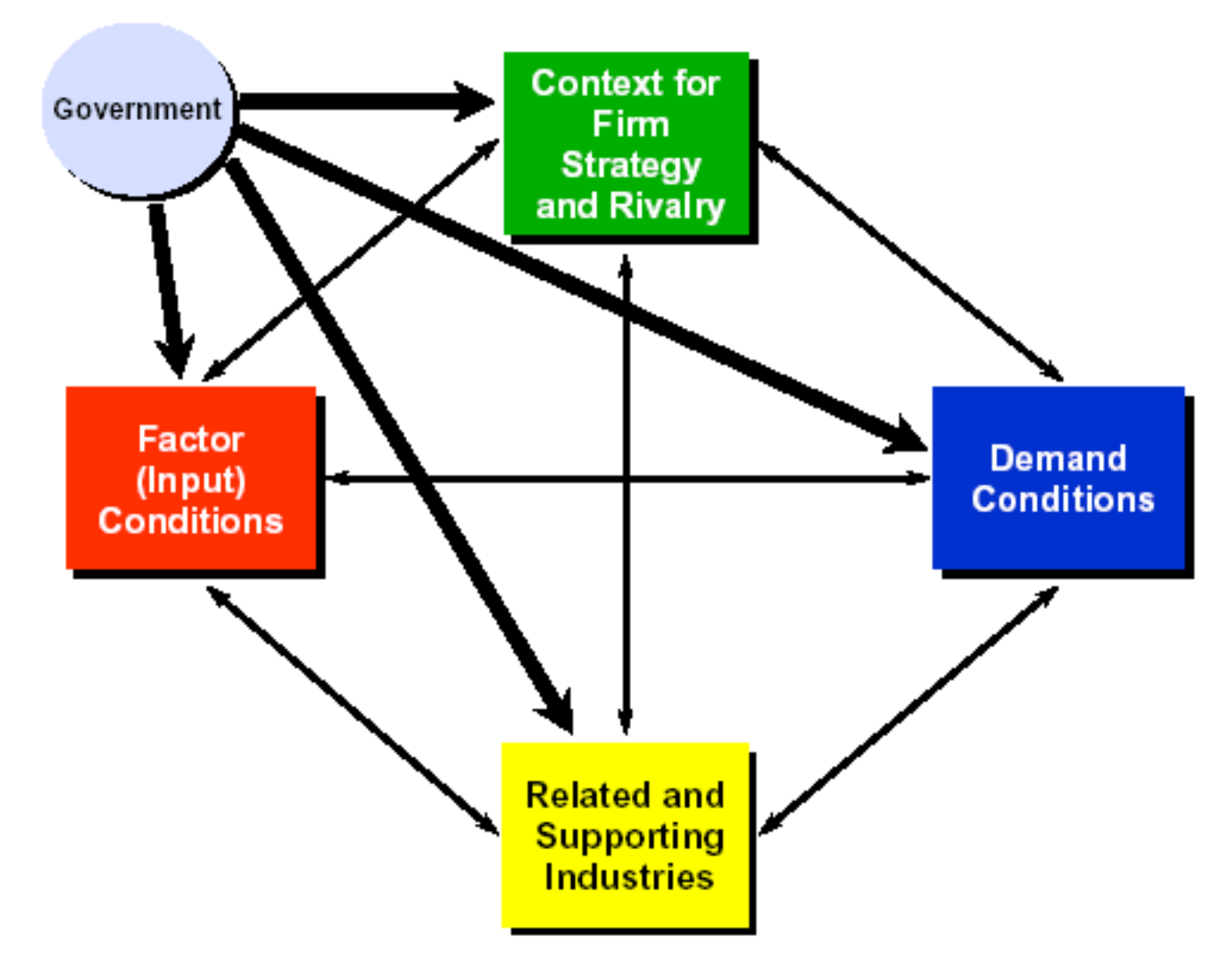
- Government’s most basic role in an economy is to achieve macroeconomic and political stability
- Government’s second role is to improve general microeconomics capacity of the economy by improving the efficiency and quality of the general purpose inputs to business
- Government’s third role is to establish the overall microeconomics rules and incentives governing competition that will encourage productivity growth
Five Forces Analysis
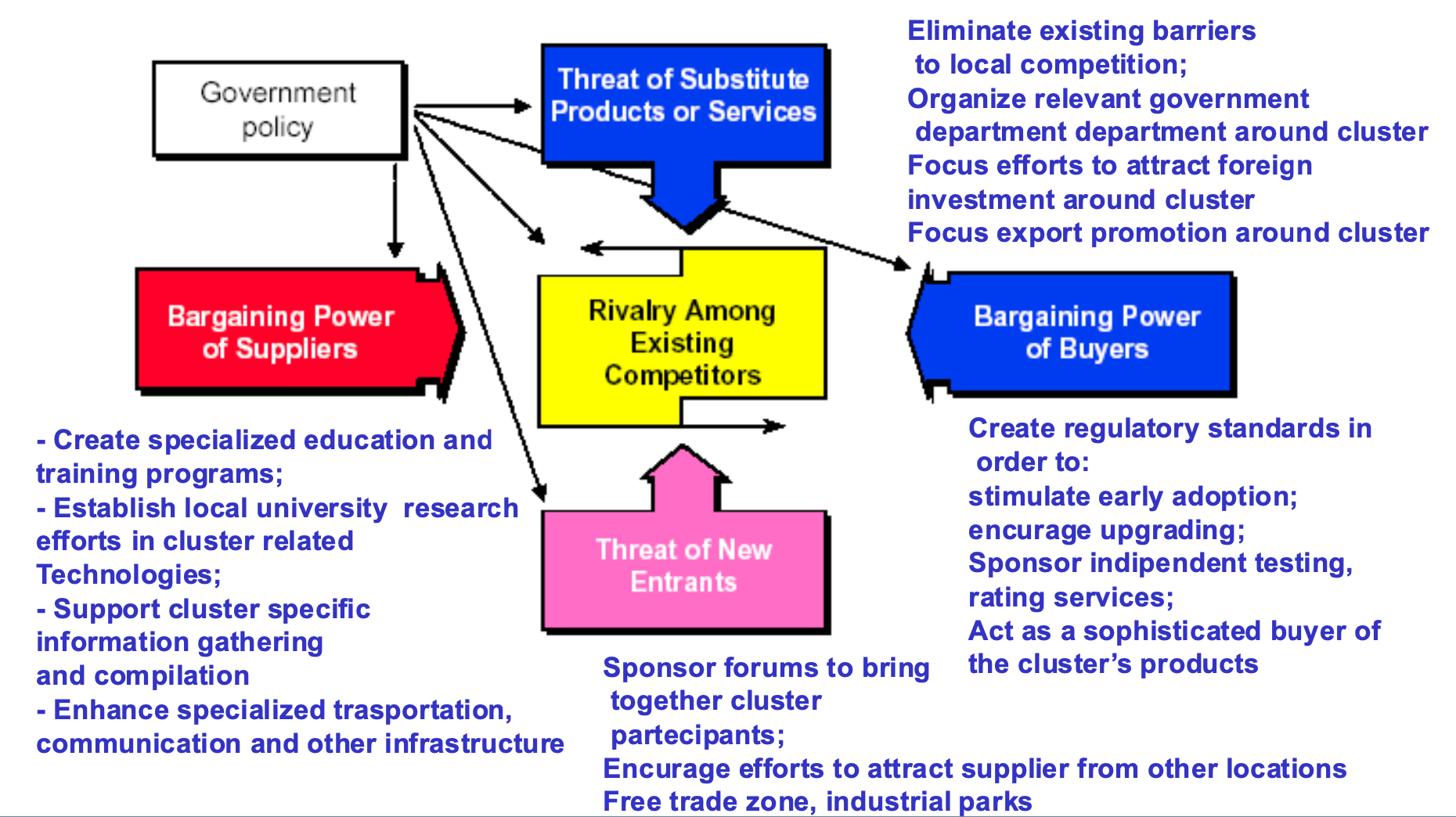
Governments influence market competition through Porter's Five Forces Framework, shaping how businesses operate and grow:
- Threat of New Entrants:
Supports networking among cluster participants, attracts new suppliers, and lowers barriers to entry. - Rivalry Among Existing Competitors:
Ensures fair competition, removes restrictive policies, and promotes foreign investment and export-driven strategies. - Threat of Substitutes:
Regulates markets to ensure competition remains balanced across alternative products and services. - Bargaining Power of Suppliers:
Enhances specialized training programs, supports R&D, and improves infrastructure to strengthen supply chains. - Bargaining Power of Buyers:
Enforces consumer protection laws and quality standards while acting as a sophisticated buyer to stimulate industry improvements.
Government Policies and the Business Environment
| Examples of Policy Areas | Examples of Policy Areas | Examples of Policy Areas | Examples of Policy Areas |
| Factor (Input) Conditions | Context for Firm Strategy and Rivalry | Demand Conditions | Related and Supporting Industries |
| Natural resource regulation, pricing, and conservation Infrastructure development, regulation, and pricing Education and training Science and technology policy Legal system Public administration Collection and dissemination of economic information Policies affecting capital market regulation | Labor laws Policies affecting incentives (e.g., tax, investment incentives, R&D tax credits) Policy toward imports and inward FDI Antitrust/competition policy Regulation of pricing, markets, capacity, and entry Policies toward state ownership Intellectual property laws | Policies (including taxation) that influence patterns of consumption Product quality, health, safety, and environmental regulations Consumer protection / information Government procurement practices Policy towards inward FDI inflows | Free trade zones / industrial parks Policy towards trade and FDI Licensing, pricing, distribution, and data policies on supplier industries Policies for regional development and the development of backward areas Policies toward state ownership |
Stages of Competitive Development
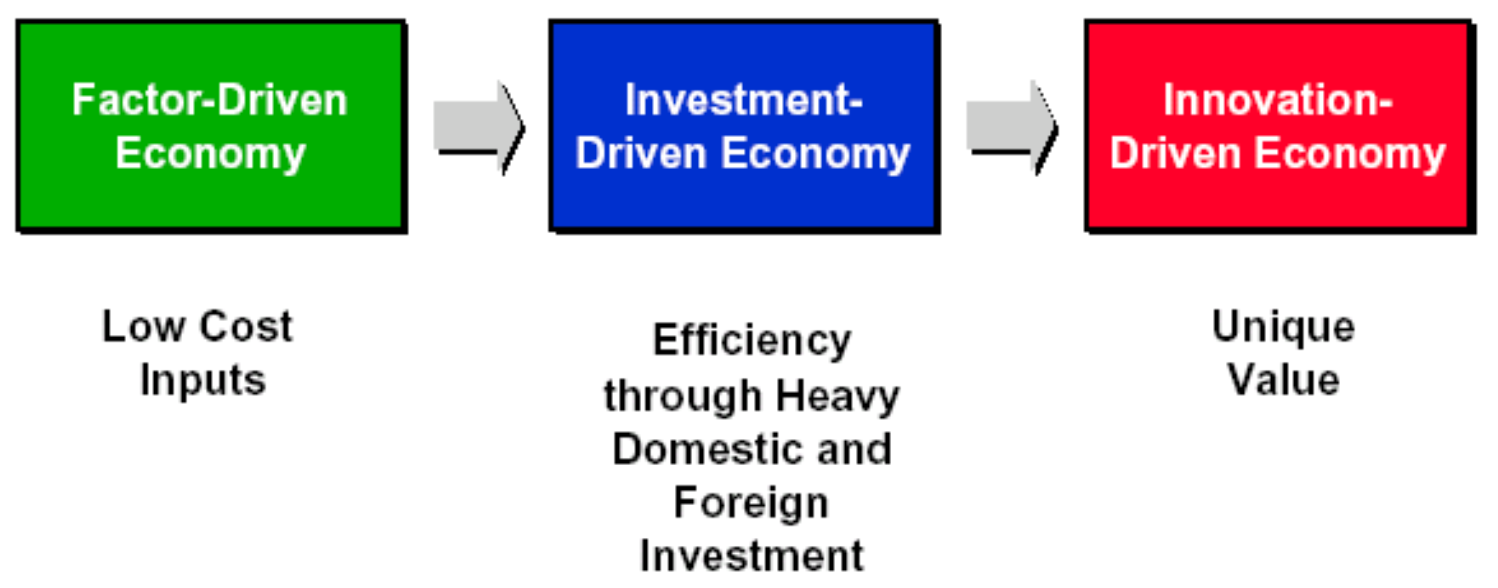
Successful economic development is a process of successive economic upgrading, in which the business environment in a nation evolves to support and encourage increasingly sophisticated ways of competing
Shifts in Economic Development Models
| Old Model | New Model |
| Focus on “Big Bang” macroeconomic and legal reform – e.g., monetary and fiscal policy, privatization, market opening Attention on relatively few cross-cutting policies Dominant focus on policy at the national level Effort is directed primarily at the passing of laws Government-driven process Relatively few parts of government involved Decisions are centrally controlled and administratively easy to implement | Focus on microeconomic upgrading e.g., business environment, company capabilities Myriad of policy areas Policy impact requires sustained effort over time Collaborative process involving multiple players Many parts of government must be involved Multiple geographic levels are relevant and important Decisions involve multiple actors and the breadth of action steps makes implementation complex |
The role of the Government in Economic Development - Principles
Roles
- The role of government is neither interventionist nor laissez faire
- Government has inevitable roles in the economy. The issue is what specific roles government plays
- Government must cease or modify negative roles to foster economic development. However, it must also step up to playing positive roles in rule setting and investment in the assets that underpin a competitive economy
- The diamond model provides the structure to understand the specific roles and appropriate policies of government
- The “productivity test”
- Government’s fundamental responsibility is to upgrade the diamond over time, and motivate and support the transition between the stages
- Government’s agenda shifts markedly by stage or competitive development. New priorities emerge as the constraints on productivity shift and some previous behaviors become counterproductive
- Government must address the economic and social agenda simultaneously because they are inextricably tied
- Government at multiple levels has important roles in competitiveness
Structure
- Government is not monolithic, and competitiveness is affected by a myriad of government entitie
- Multiple agencies or departments (e.g., finance, trade, education, science and technology, commerce, regional policy, energy, agriculture)
- Multiple policy areas
- Multiple governmental levels (nations, states, cities, etc.)
- Intergovernmental relations with neighboring countries
- “Economic” agencies and “social” agencies
- Competitiveness is rarely the sole agenda of a single government agency but cuts across many agencies
- A structure is needed (e.g., “competitiveness policy council”) that brings together the ministers and department heads necessary to formulate and implement an economic strategy
Effectiveness
- The effectiveness of government itself is crucial, and varies dramatically across countries
- Quality of the people, processes, and technology
- Extent of meritocracy in hiring and advancement
- Influence of corruption
- Relative pay versus other sectors
- Corruption in government is inextricably tied not only to the legal system and human resource practices involving government officials (e.g., selection, compensation), but also with the quality of specific economic policies (e.g., complexity of tariffs, permits, required approvals)
Process of Economic Change
- Processes and structures for mobilizing economic change have a strong influence on economic development
- A crucial part of government’s role is to engage constructively with firms and other institutions
- An important strength of government leadership is the capacity for self criticism, introspection, and taking a long-term perspective
- Successful countries have in place the common vision, institutions and mindsets to sustain competitive upgrading through changes in government
National Economic Strategy