Clusters
Overview
- A new way of thinking about an economy, competitiveness, and the sources of innovation
Better aligned with the nature of competition among locations than traditional thinking focused on individual firms, single industries, or broad sectors such as manufacturing or agriculture.
- Captures important linkages in terms of technology, skill, information, customer needs, and marketing that cut across firms and industries. Such linkages are fundamental to productivity and the direction and pace of innovation
- A new way of organizing economic development activities
- Recasts the roles of government, the private sector, trade associations and educational and research institutions
- Creates a forum for constructive business-government dialog
- Brings together firms of all sizes
- Reveals constraints facing the economy that go beyond generic, cross-cutting problems
- A means to identify common opportunities, not just common problems
- Informs both economic and social policies
What Is a Cluster?
- A cluster is a system of interconnected firms and institutions the whole of which is greater than the sum of the parts. (i)
- A cluster is a geographically proximate group of interconnected companies and associated institutions in a particular field, linked by commonalities and complementarities (ii)
- Clusters affects competition in three broad ways:
- By increasing the productivity of constituent firms;
- By increasing the capacity for innovation and for productivity growth;
- By stimulating new business formation
A geographically proximate group of interconnected companies and associated institutions in a particular field, linked by commonalities and complementarities
- An end product industry or industries
- Downstream or channel industries
- Supplier industries, especially specialized suppliers
- Providers of specialized services
- Related industries (those with important shared activities, technologies, channels, customer relationships)
- Financial institutions
- Infrastructure providers
- Educational, training, research and standard setting institutions
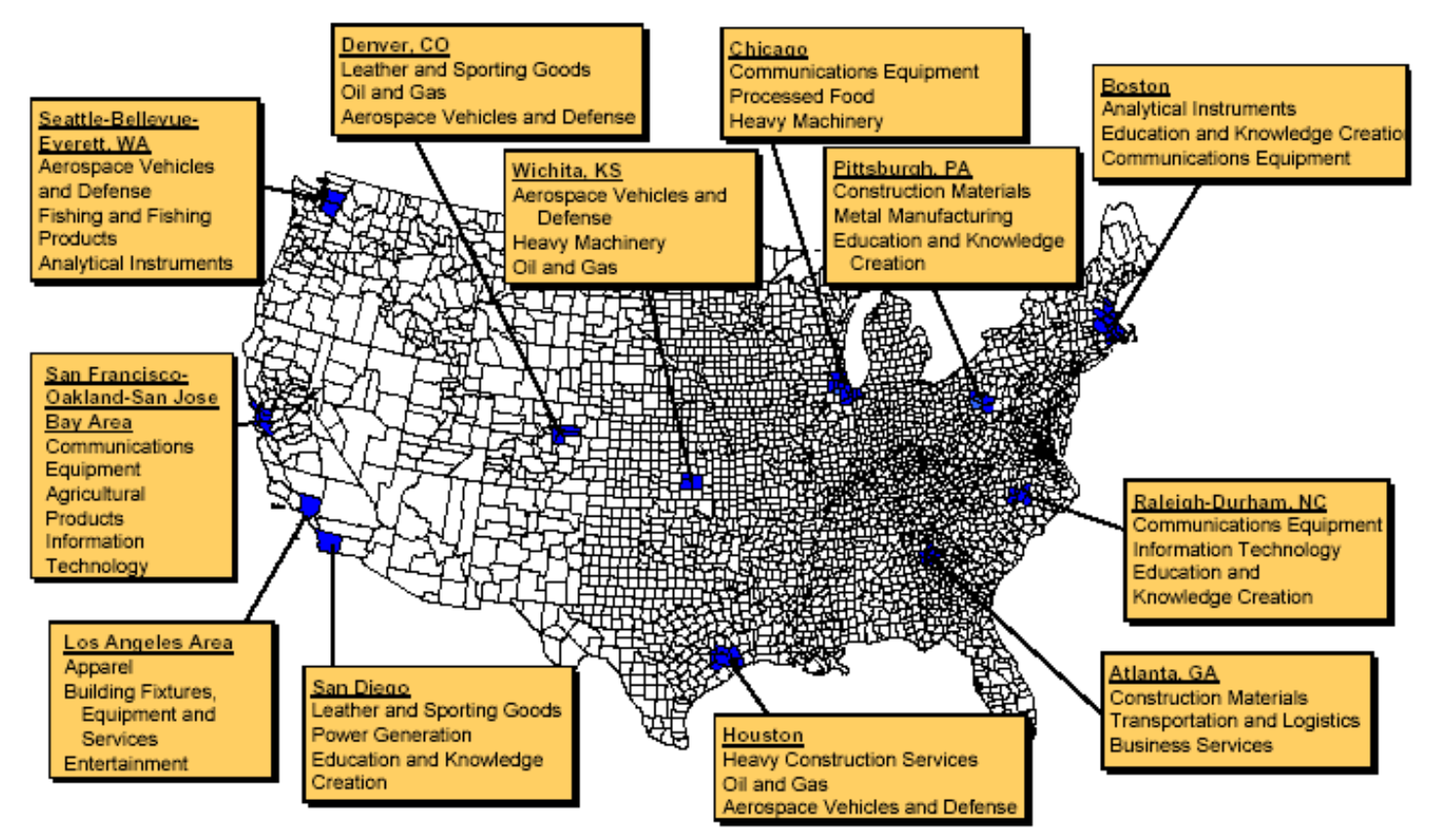
- The geographic scope of clusters varies
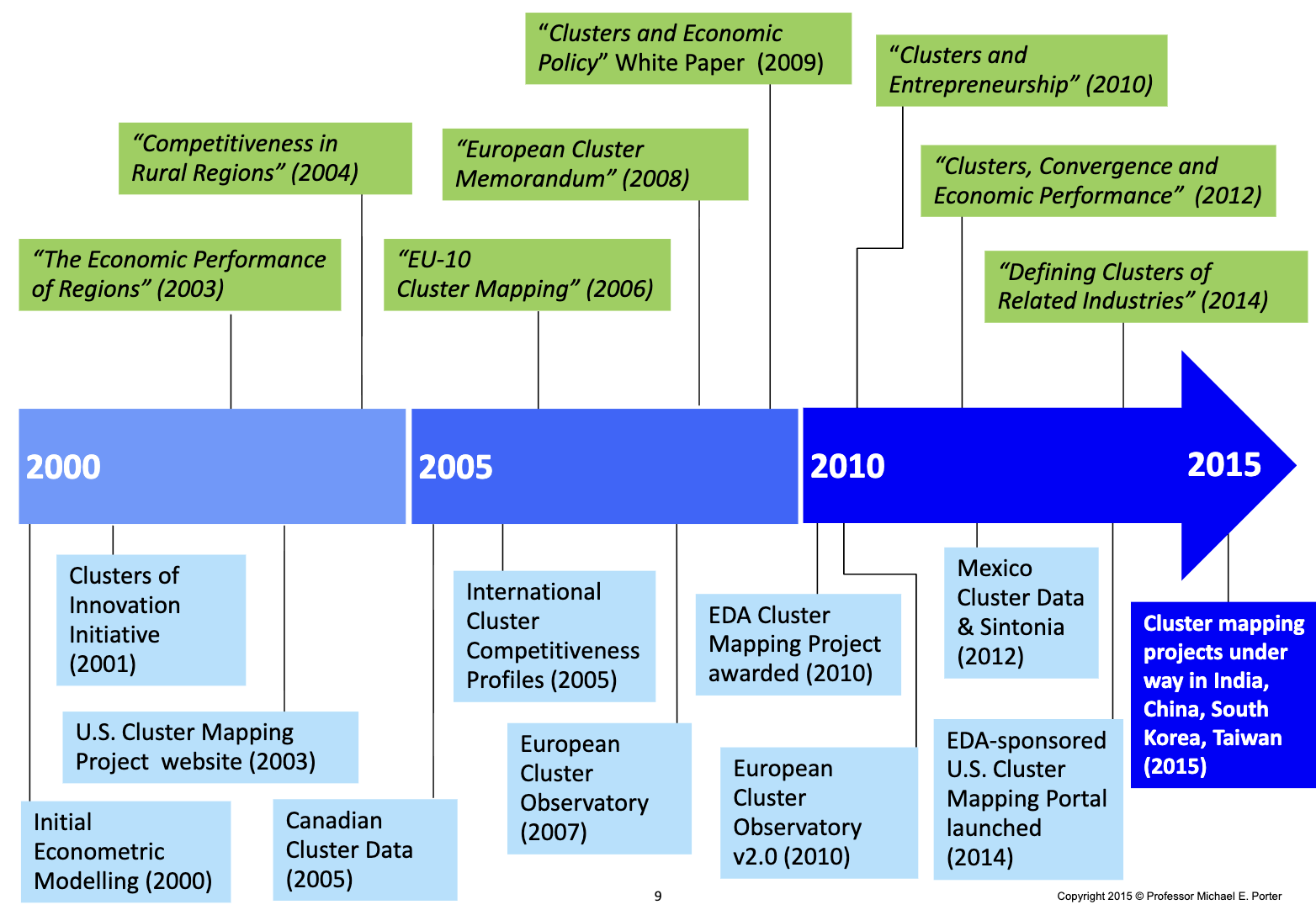
Evolution of Cluster Research and Cluster Mapping
How to Analyse a Cluster
To identifying the constituent parts of a cluster you have to follow a 4 steps process:
- Start with a large firm or a concentration of like firms and then look upstream and downstream in the vertical chain of firms and institutions;
- Look horizontally to identify industries that pass through common channels or that produce complementary goods;
- Identify the institutions that provide specialized skills, technology, information and capital;
- Seek out government and regulatory bodies that significantly influence participants in the cluster.
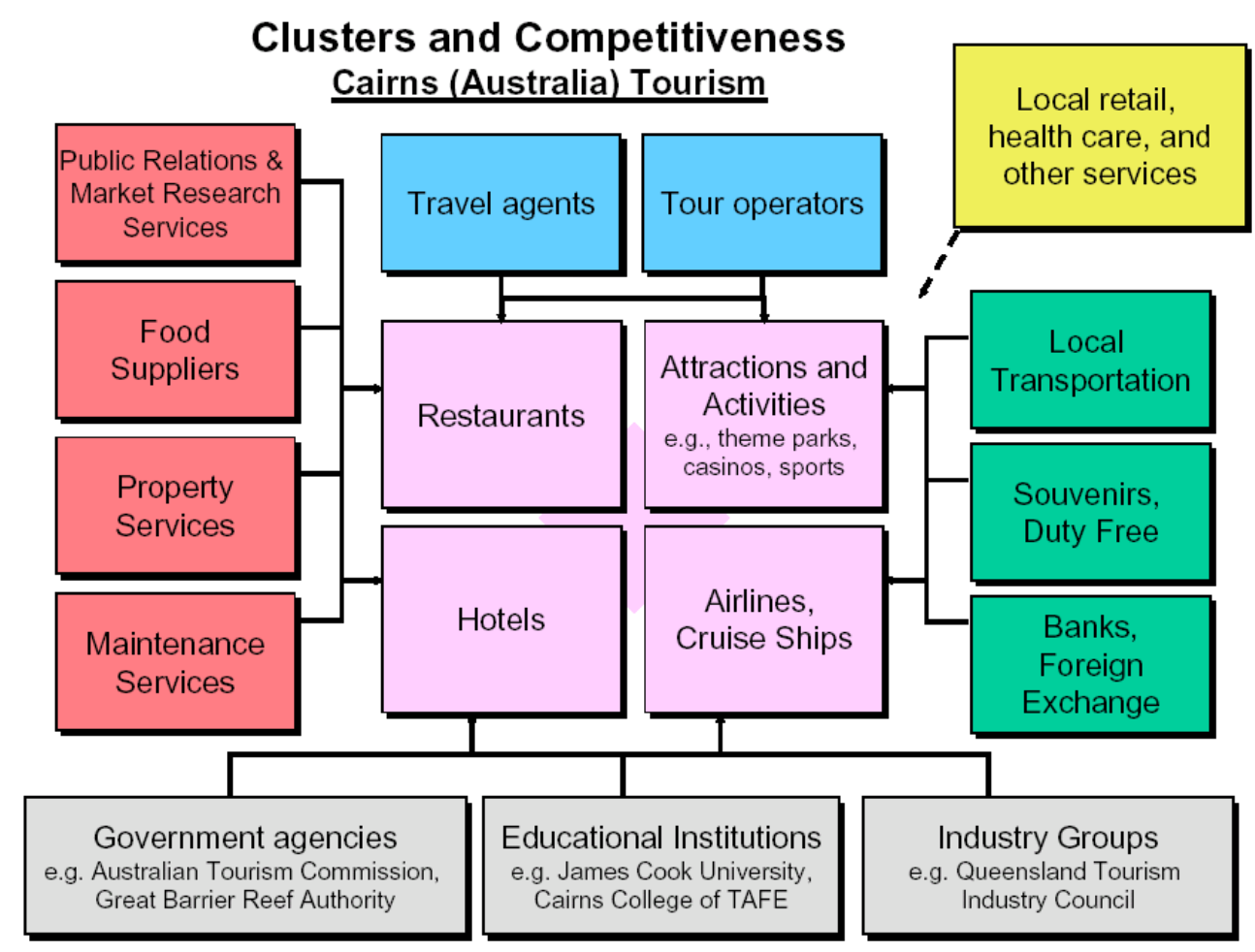
The Cluster Map
Cairns (Australia) Tourism
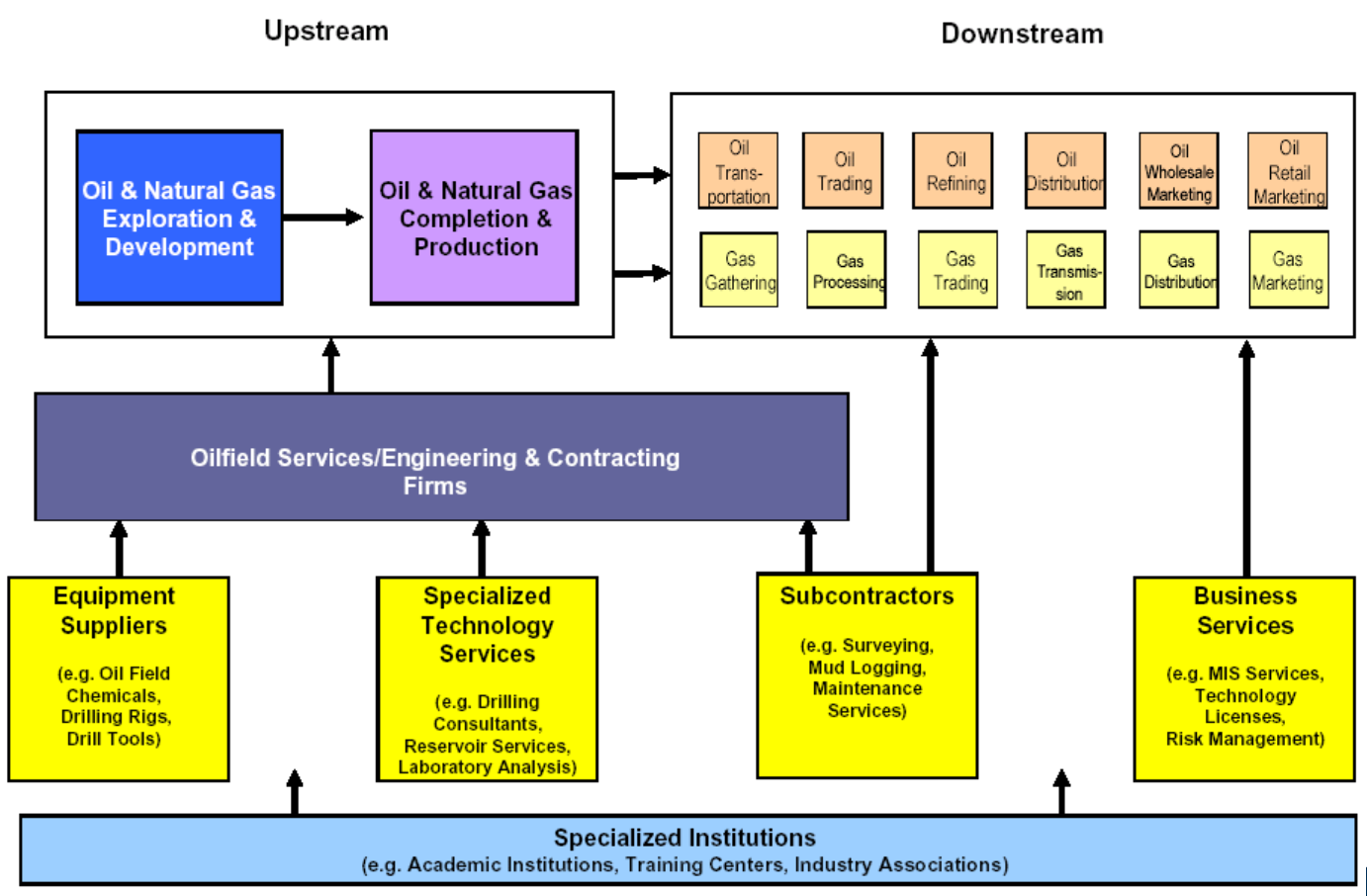
The Houston Oil and Gas Cluster
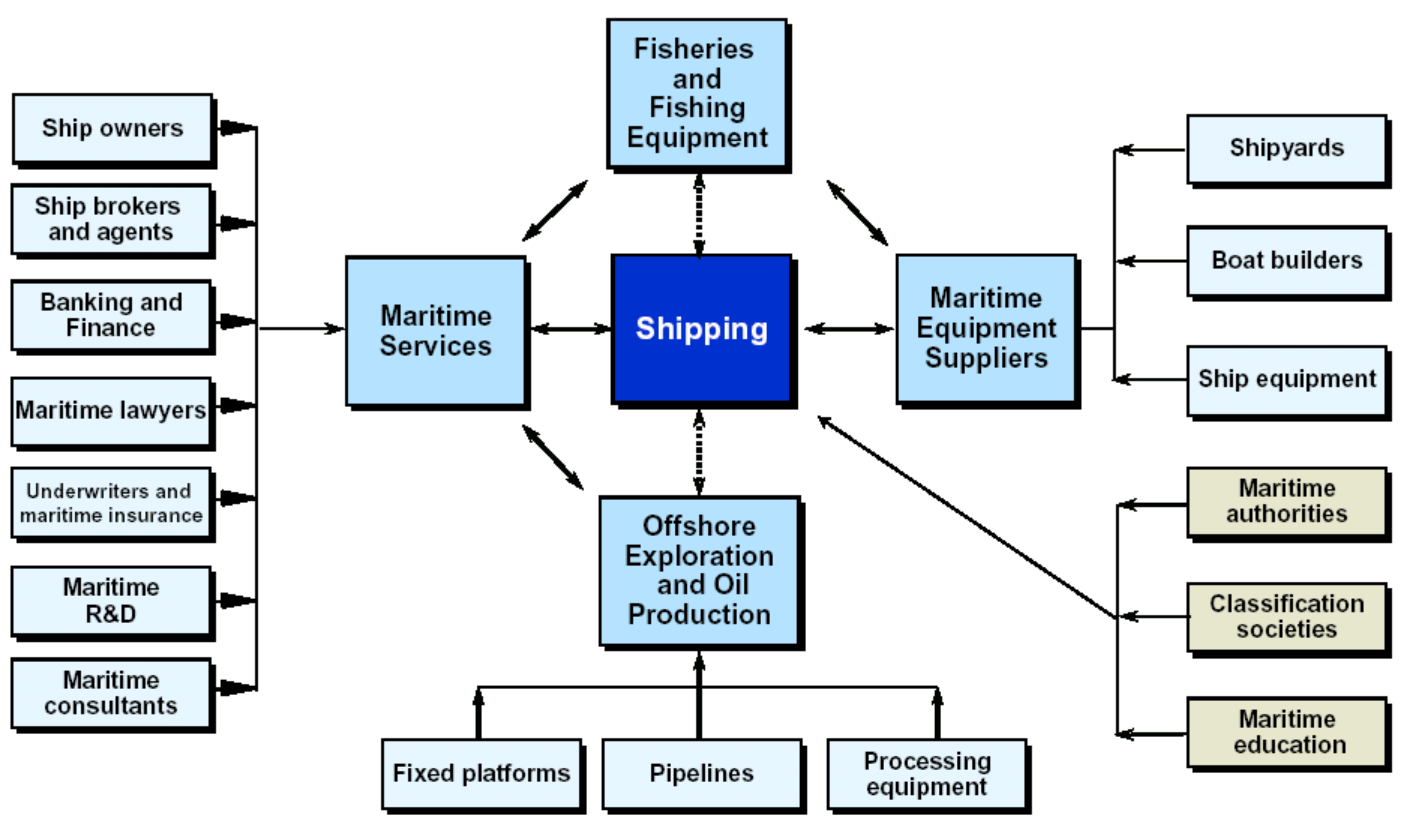
The Norwegian Maritime Cluster
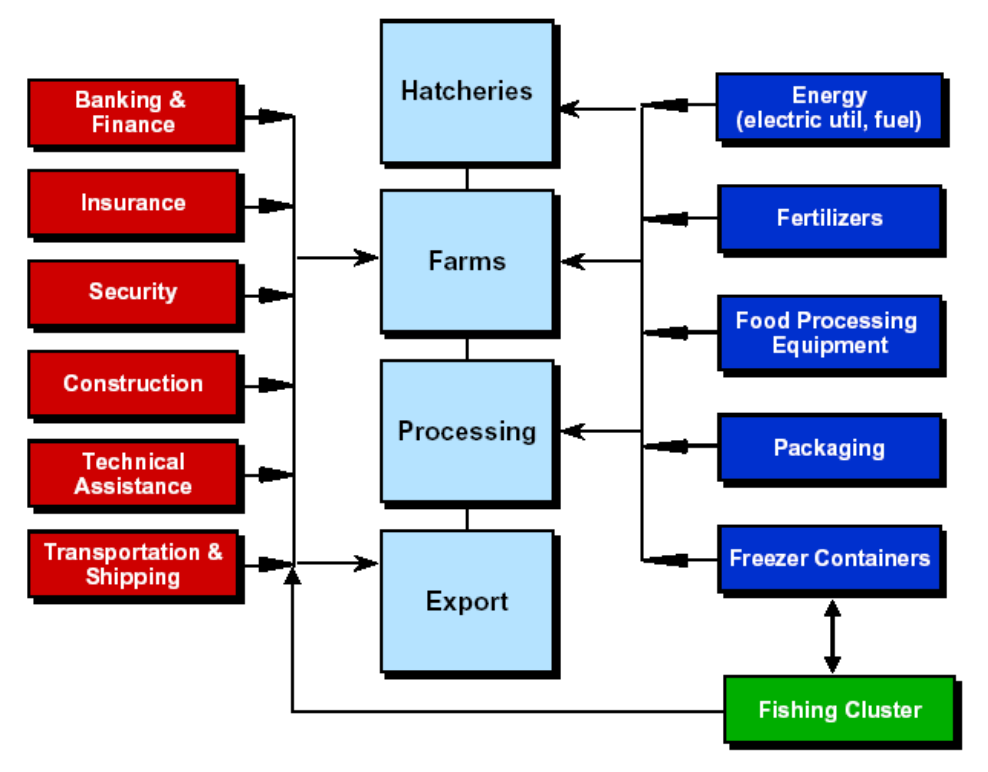
The Ecuadorian Shrimp Farming Cluster
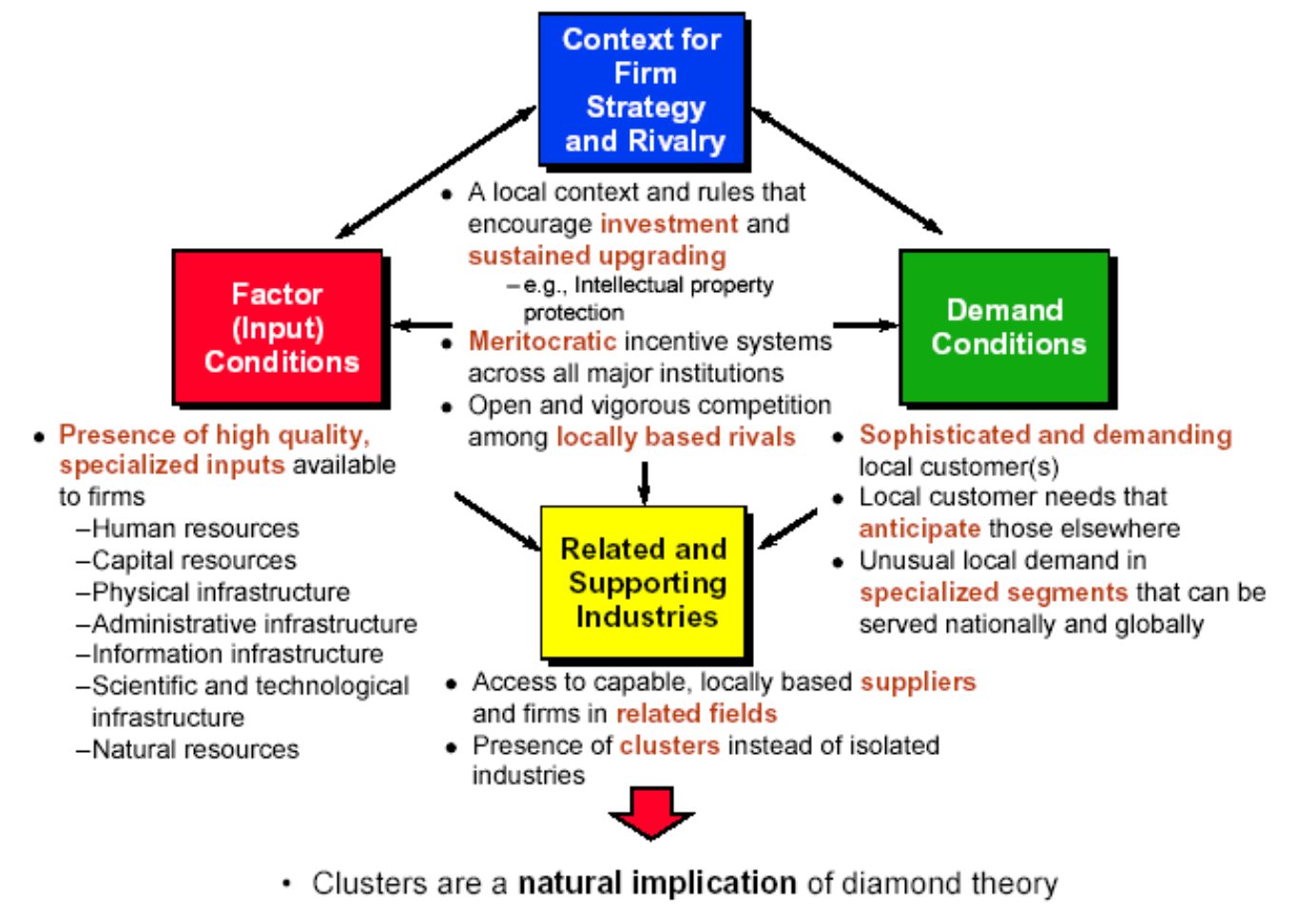
The Cluster Diamond
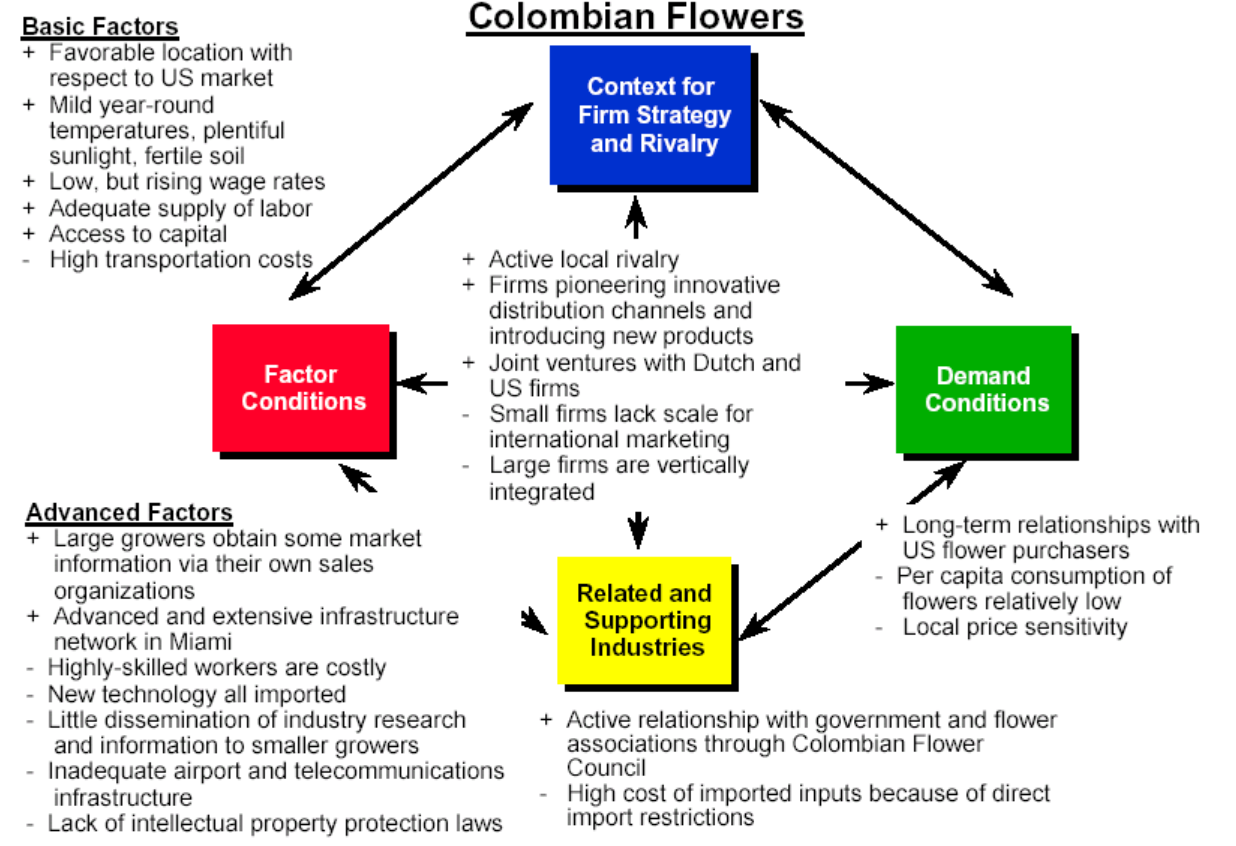
Colombian Cut Flowers
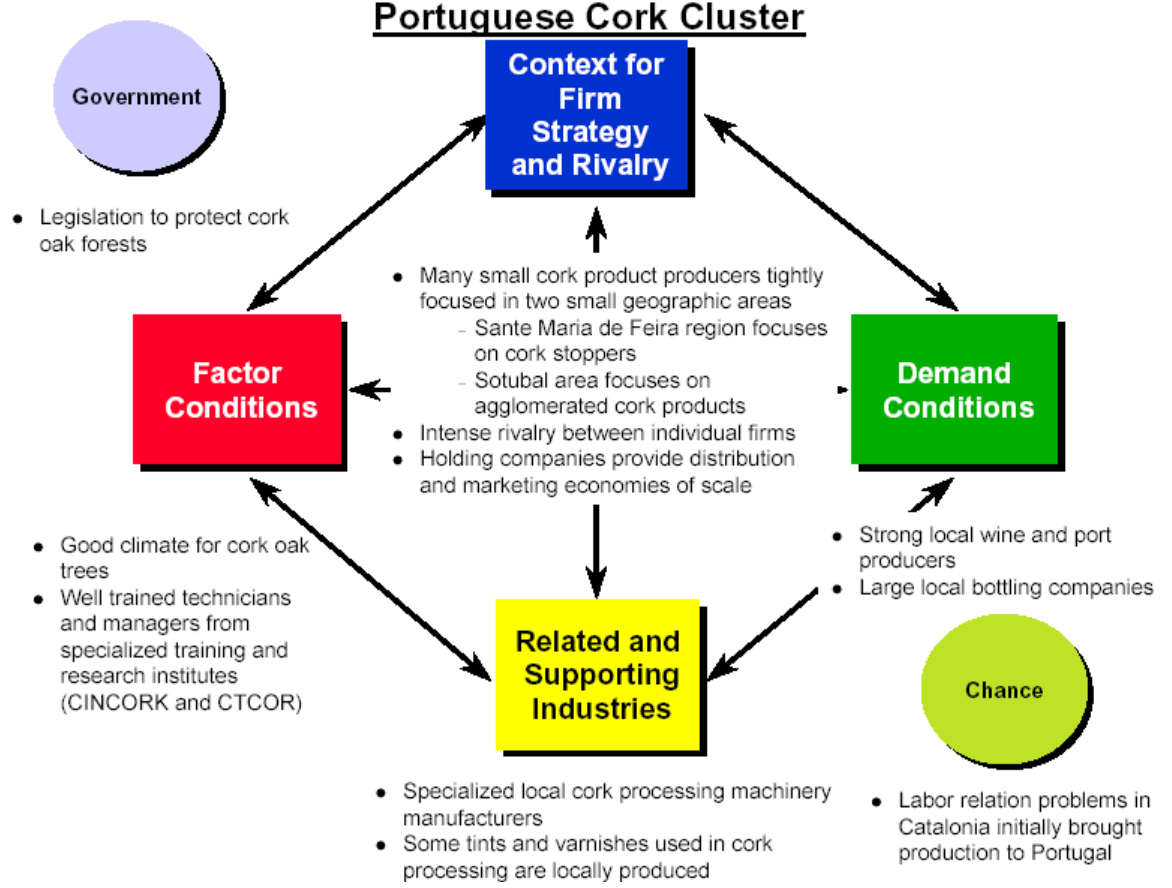
Portuguese Cork Cluster
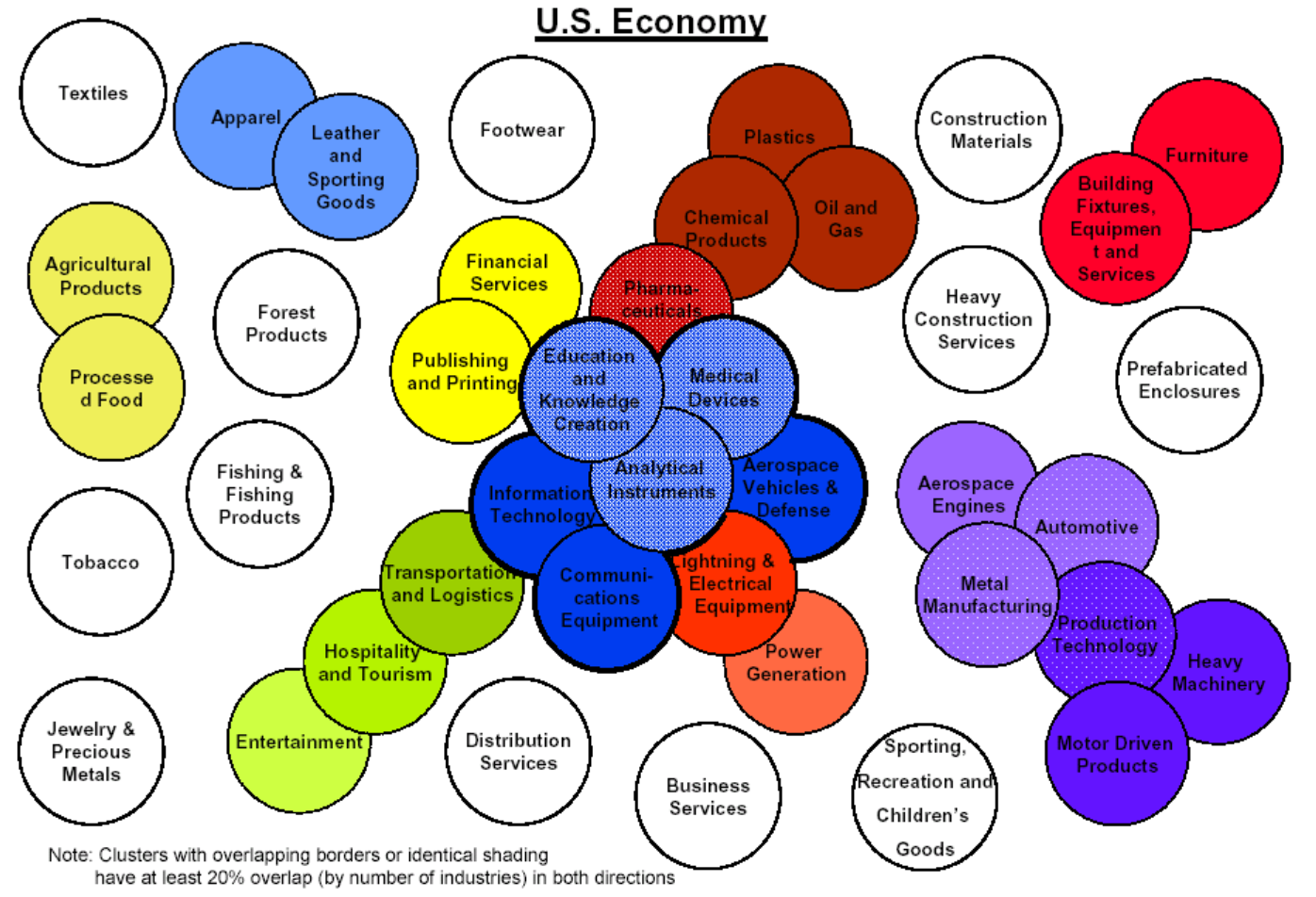
Cluster Overlap: Schematic Representation
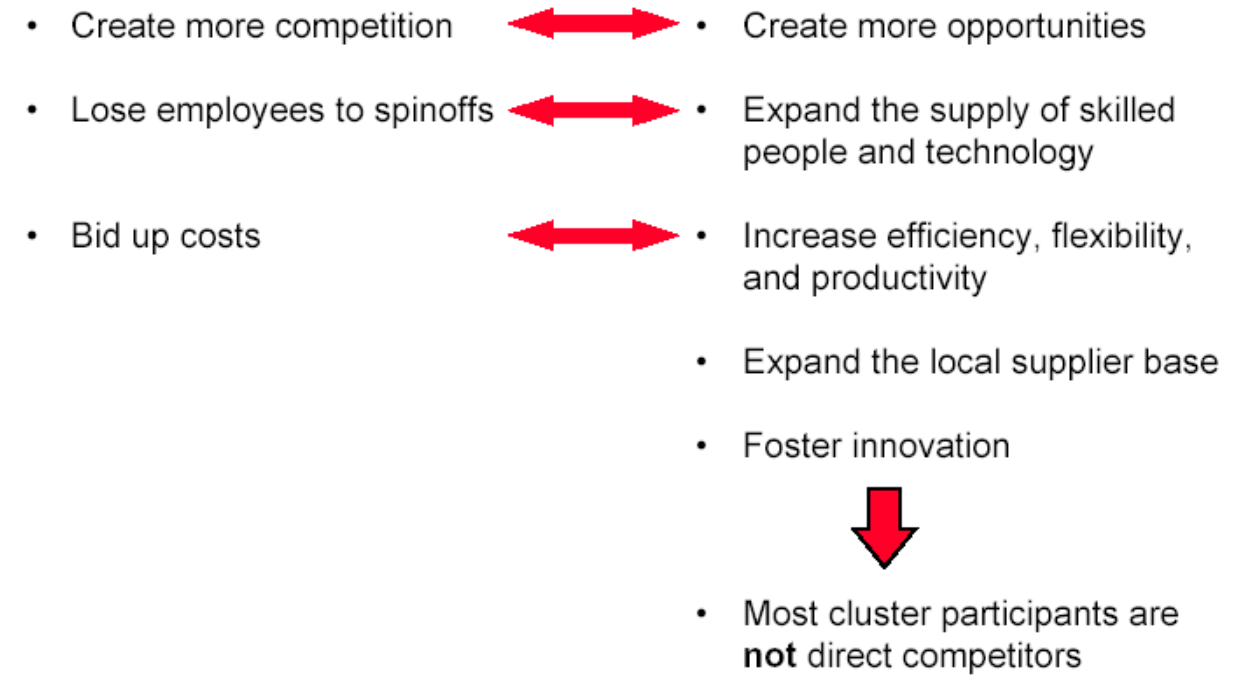
Cluster and Competitiveness
Clusters Increase Productivity and Efficiency
- Efficient access to specialized inputs, services, employees, information, institutions, and “public goods” (e.g., training programs)
- Ease coordination and transactions across firms
- Rapid diffusion of best practices
- Ongoing, visible performance comparisons and strong incentives to improve vs. local rivals
Clusters Stimulate and Enable Innovation
- Enhanced ability to perceive innovation opportunities
- Presence of multiple suppliers and institutions to assist in knowledge creation
- Ease of experimenting given locally available resources
Clusters Facilitate Commercialization
- Opportunities for new companies and new lines of business in established companies are more apparent
- Commercializing new products and starting new companies is easier because of available skills, suppliers, etc.
Clusters reflect the fundamental influence of externalities / linkages across firms and associated institutions in competition.
Strong Clusters Drive Regional Performance
| Cluster Profile (Research) |
|
| Regional Performance Outcomes |
|
Dynamic Processes Within Healthy Clusters
- Trial, error, and observation
- Role models motivate other companies
- Pluralism feeds experimentation
- Intensive concentration of information about the field
e.g., needs, technology, processes - Apprenticeship: “watch and learn” the business
- Dense, overlapping personal networks and enabling institutions (IFCs) facilitate exchange and collaboration
- Spin-off firms disperse skill and technology and foster migration into new segments
- Embedded specialized universities and other institutions disperse skill and knowledge
While some benefits of clusters are automatic, many of the most important involve organization and active efforts by participants
Skills and Technology
- Dense, overlapping personal networks arise, supported by enabling institutions (e.g., IFCs) that facilitate exchange and collaboration
- Employees move among companies, migrating specialized skills
- Apprenticeships are common; individuals “watch and learn” the business
- Specialized university programs and other institutions embedded in the cluster grow up and disperse skills and technology
Innovation
- Intensive concentration of knowledge accumulates in the field
- e.g., needs, technology, processes
- Co-location of companies feeds experimentation
- Trial, error, and observation occurs
Competition
- Spin-off firms disperse skills and technology, and foster migration into new segments
- Role models motivate other companies
- Rivalry is personal and intense
- While some cluster benefits are automatic, many of the most important benefits of clusters are enhanced by organizing the cluster and by active efforts to capitalize on cluster benefits by participants.
Company Attitudes Toward Clusters
Evolution and Decline of Clusters
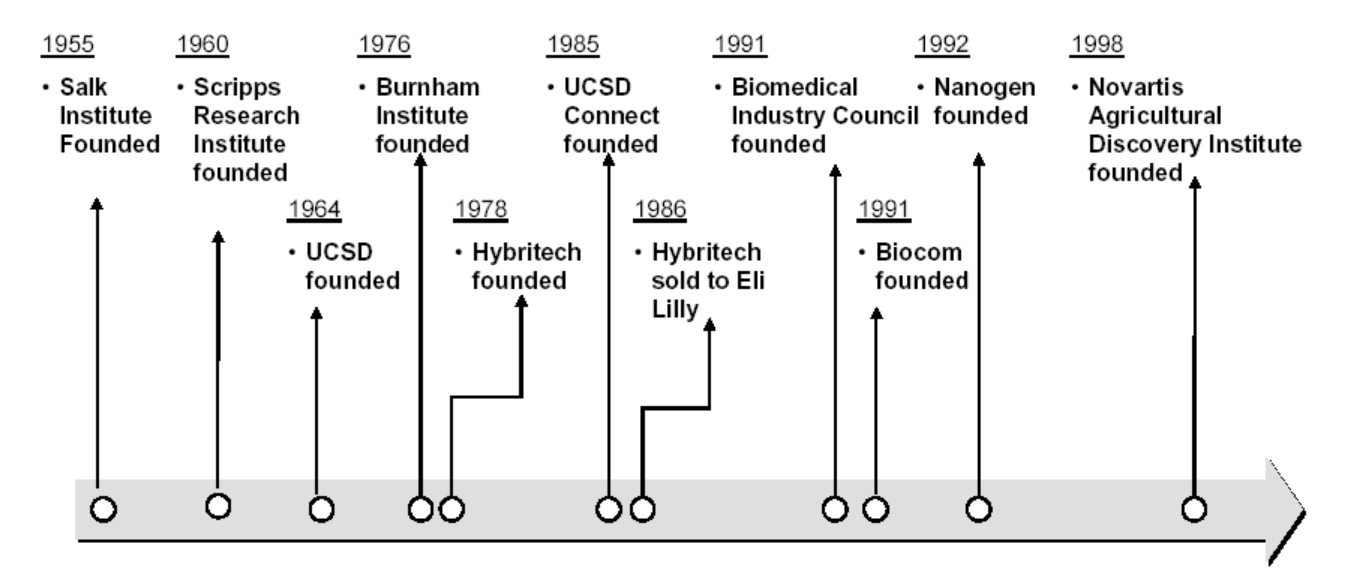
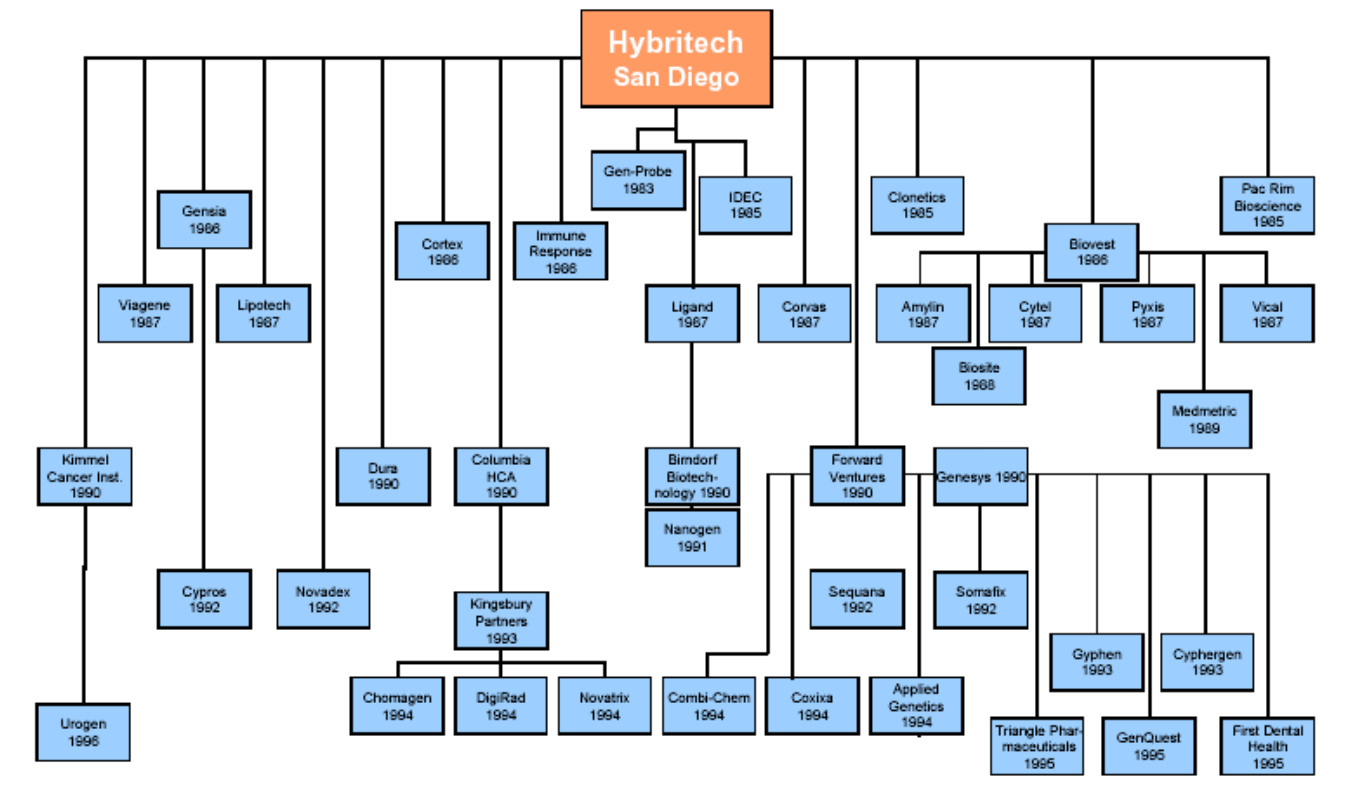
Cluster Evolution
- The roots of clusters often reflect historical circumstances or are influenced by chance events
- Local factor inputs
- Local demand conditions
- Prior industries / clusters
- Acts of entrepreneurship
- Other unpredictable events (e.g., natural disasters, wars, disruptions of trade)
- A critical mass (which can be a single dynamic company) triggers a self-reinforcing process in which suppliers emerge, local institutions specialize, information accumulates, local rivals are attracted, visibility rises, prestige grows
- Spin-offs and entrepreneurial efforts by employees feed new business formation and rivalry
- As the cluster grows and reinforces itself, it develops greater influence over public policy decisions and the choices and investments of local institutions such as universities, schools, and IFCs
Cluster Decline
- Buyer needs substantially change
- Technological discontinuities arise
- Rising local costs of doing business outrun the value of specialization
- Internal rigidities set in due to regulations, union rules, or institutional weaknesses
- Lack of rivalry, monopoly, or market dominance slows down innovation
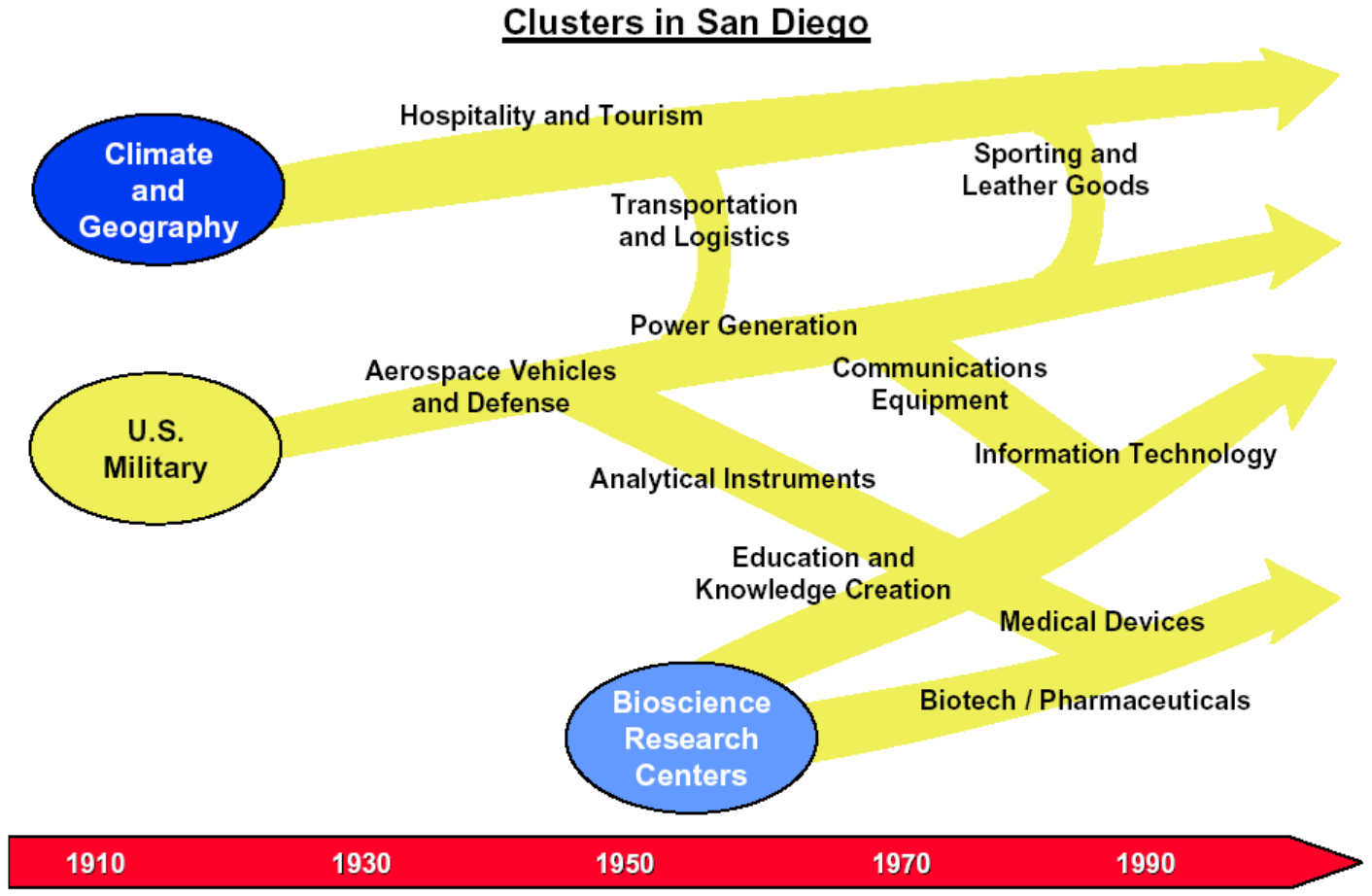
The Evolution of Regional Economies
New Roles of the Private Sector in Economic Development
- A company’s competitive advantage is partly the result of the local environment
- Company membership in a cluster offers collective benefits
- Private investment in “public goods” is justified
- Take an active role in upgrading the local infrastructure
- Nurture local suppliers and attract new supplier investments
- Work closely with local educational and research institutions to upgrade quality and create specialized programs addressing cluster needs
- Provide government with information and substantive input on regulatory issues and constraints bearing on cluster development
- Focus corporate philanthropy on enhancing the local business environment
- An important role for trade associations
- Greater influence
- Cost sharing
Cluster Activation
- Clusters are critical engines of economic development
- Clusters enable companies to improve performance and seize market opportunities otherwise unavailable to them
- Clusters are especially important for fostering new business formation
- Clusters are a forum to identify important challenges in the business environment, and hence key agenda items for government
- Clusters provide an opportunity for government, companies, and other institutions to work constructively together in economic development
- Clusters should be a core element of any competitiveness effort
Public/Private Cooperation in Cluster Upgrading
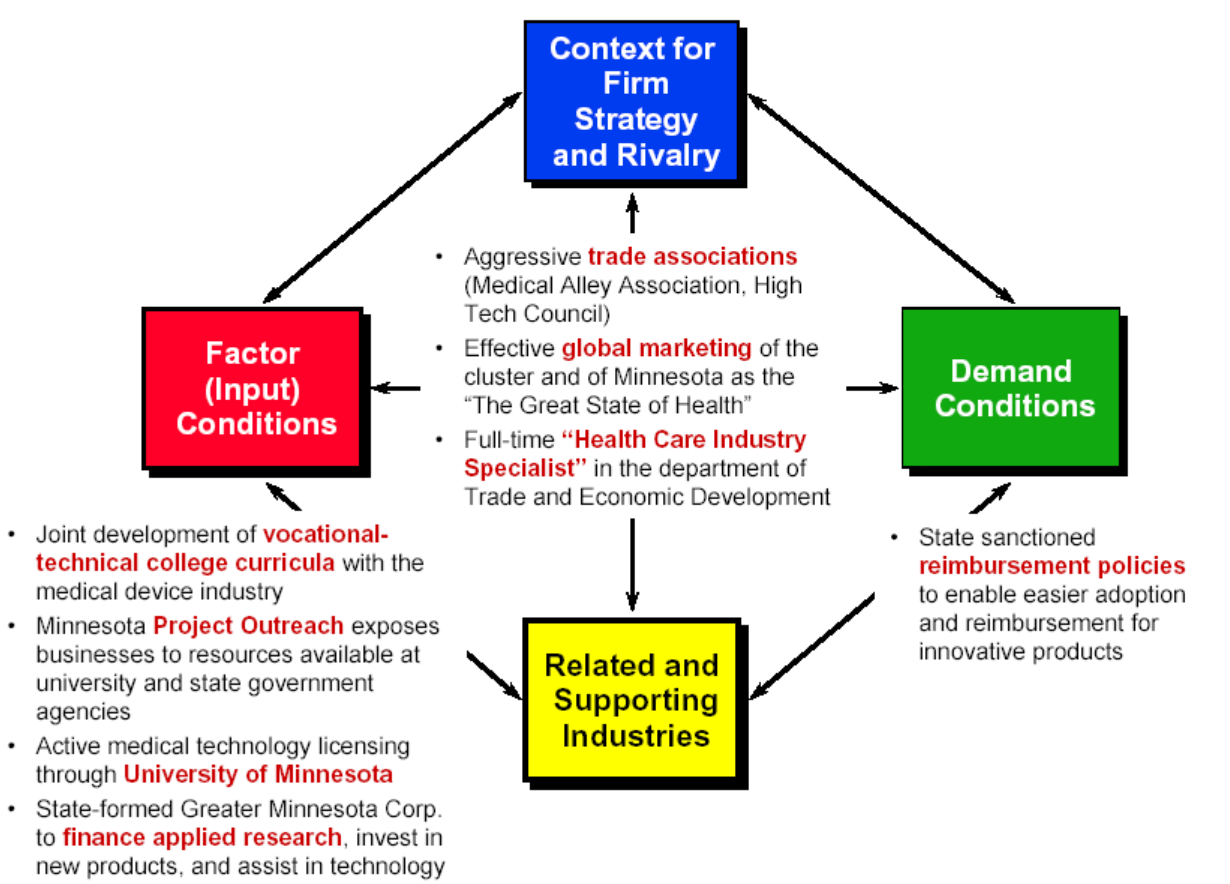
Clusters and Economic Policy
Implications
- Cluster policies are more cost effective and less distortive than policies targeted at individual companies and industries
- Cluster based policies aim to enhance positive externalities within clusters through:
- Incentives for investment
- Platforms for collective action
- Cross institutional alignment and collaboration
- More effective public policy implementation
- All clusters are good and policy should enable any cluster to upgrade
- Cluster theory and cluster policy are neutral across clusters. Picking winners, tax preferences, or subsidies for inputs or firms are a misuse of cluster theory
- Cluster based policies typically involve private-public partnerships (which is different from government intervention or protection)
- Funding should involve private sector investments or matching funds
Cluster in Developing Countries
Indian Movie Cluster ("Bollywood")
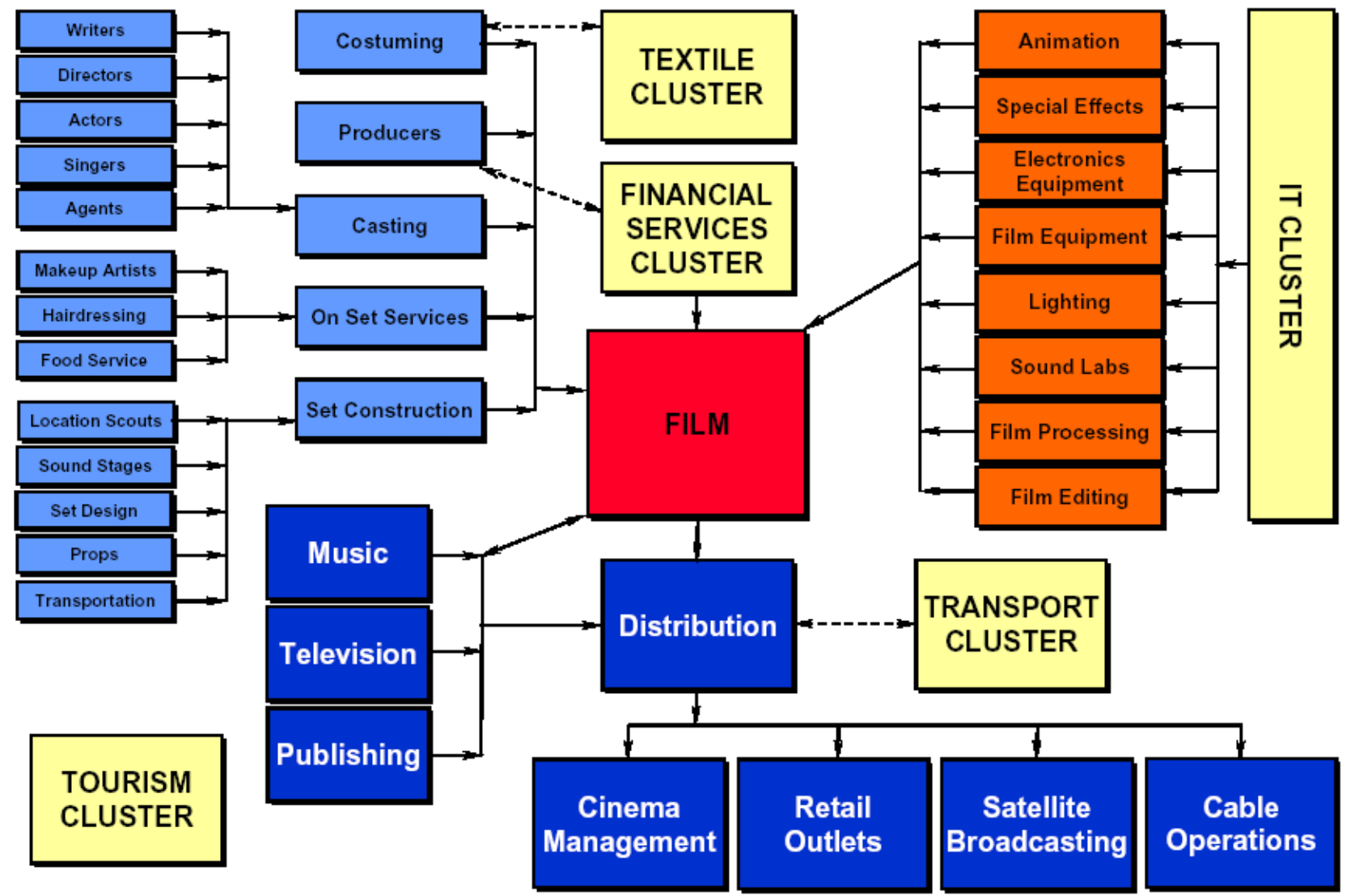
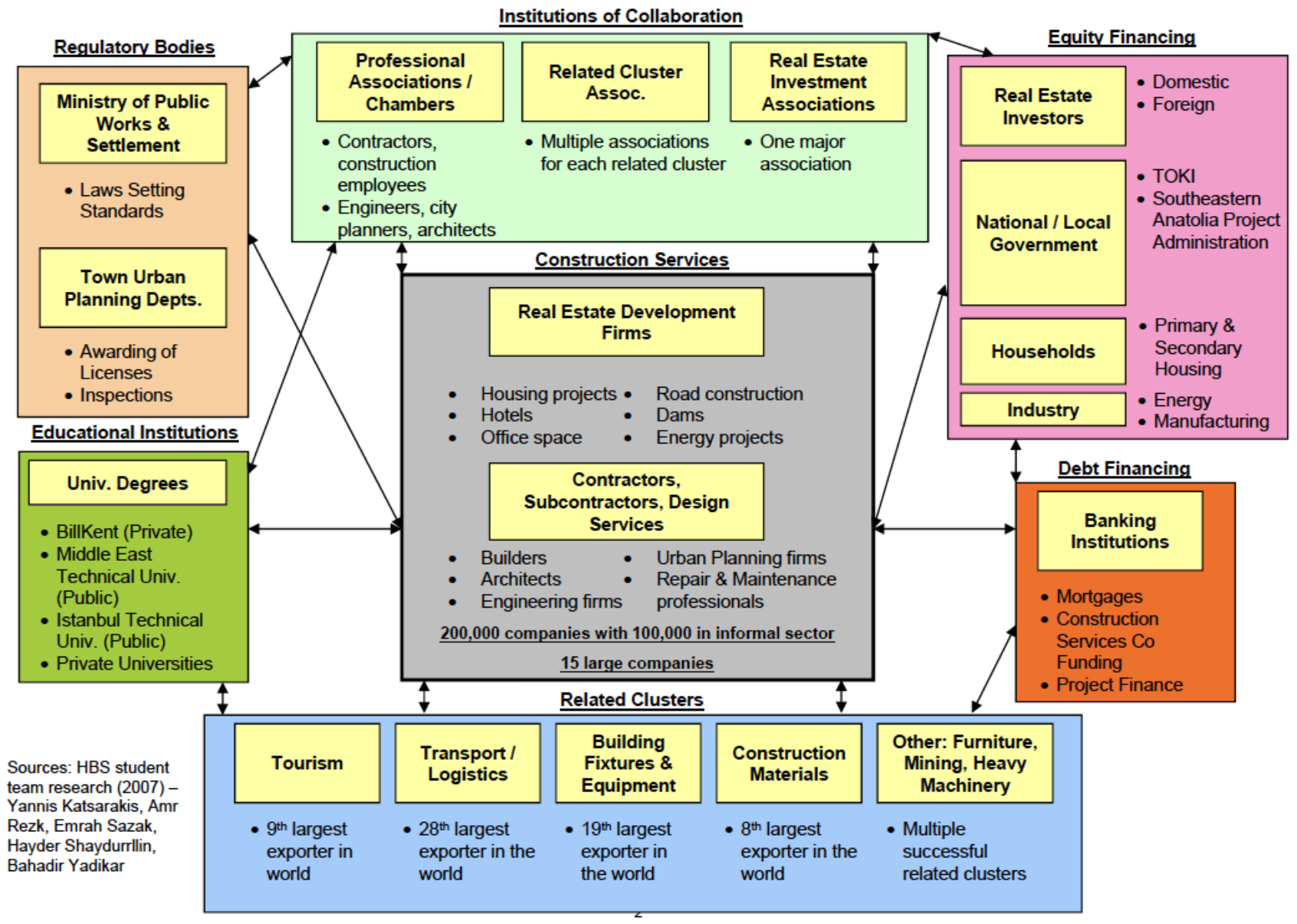
Turkish Construction Cluster
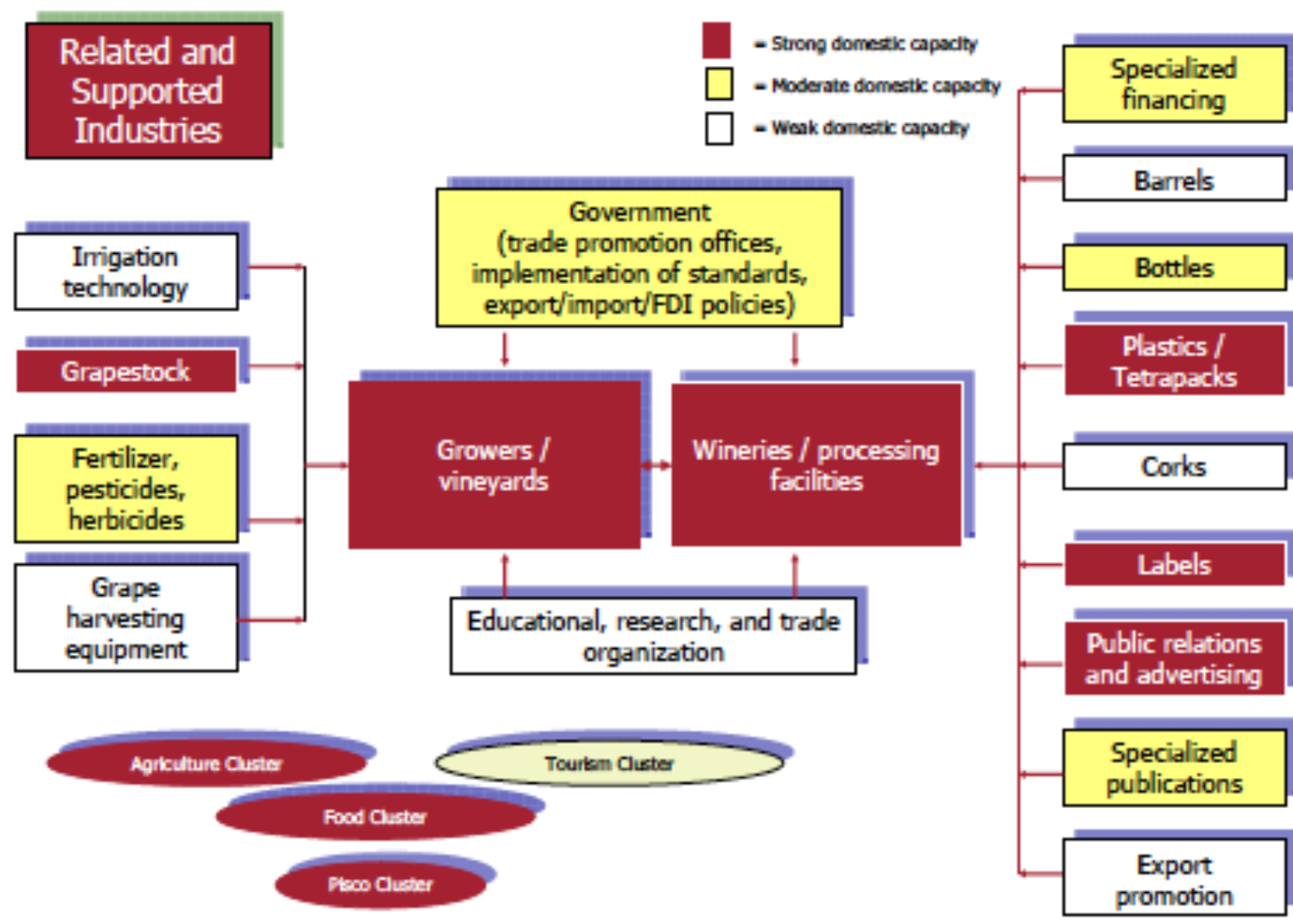
Chilean Wine Cluster
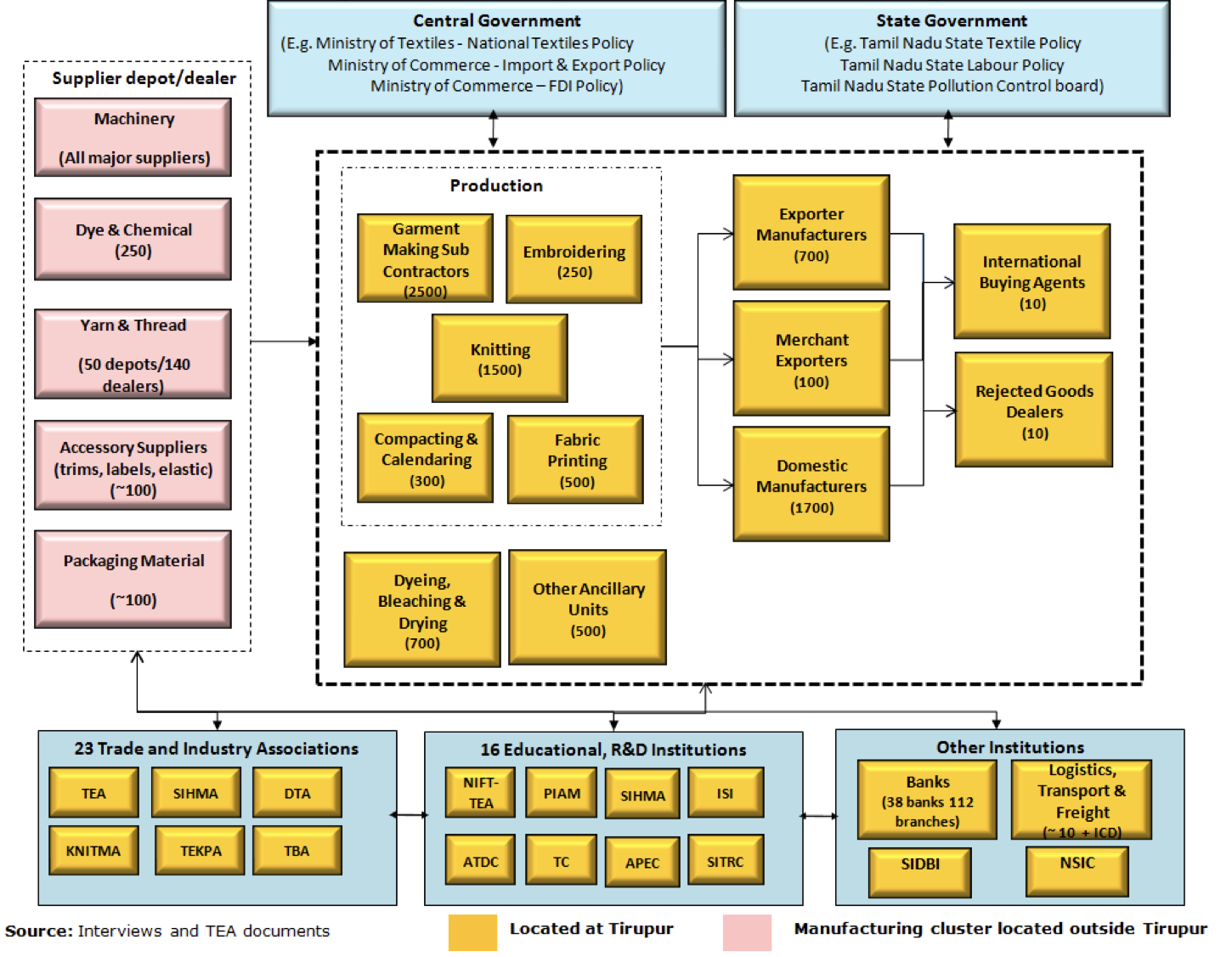
Indian Tirupur Knitwear Cluster
Levels of Clusters
- There is often an array of clusters in a given field in different locations, each with different areas of specialization, depth, and sophistication
- Global innovation centers, such as Silicon Valley in semiconductors, tend to be few in number. If there are multiple innovation centers, they normally specialize in different market segments
- Other clusters in the same field focus on manufacturing, outsourced service functions, or play the role of regional assembly or service centers
- Firms based in the most advanced clusters often seed or enhance clusters in other locations in order to reduce the risk of a single site, access lower cost inputs, or better serve particular regional markets
- The challenge for a developing economy is to move from isolated firms to clusters, and then to upgrade the breadth and sophistication of each cluster to encompass more advanced activities
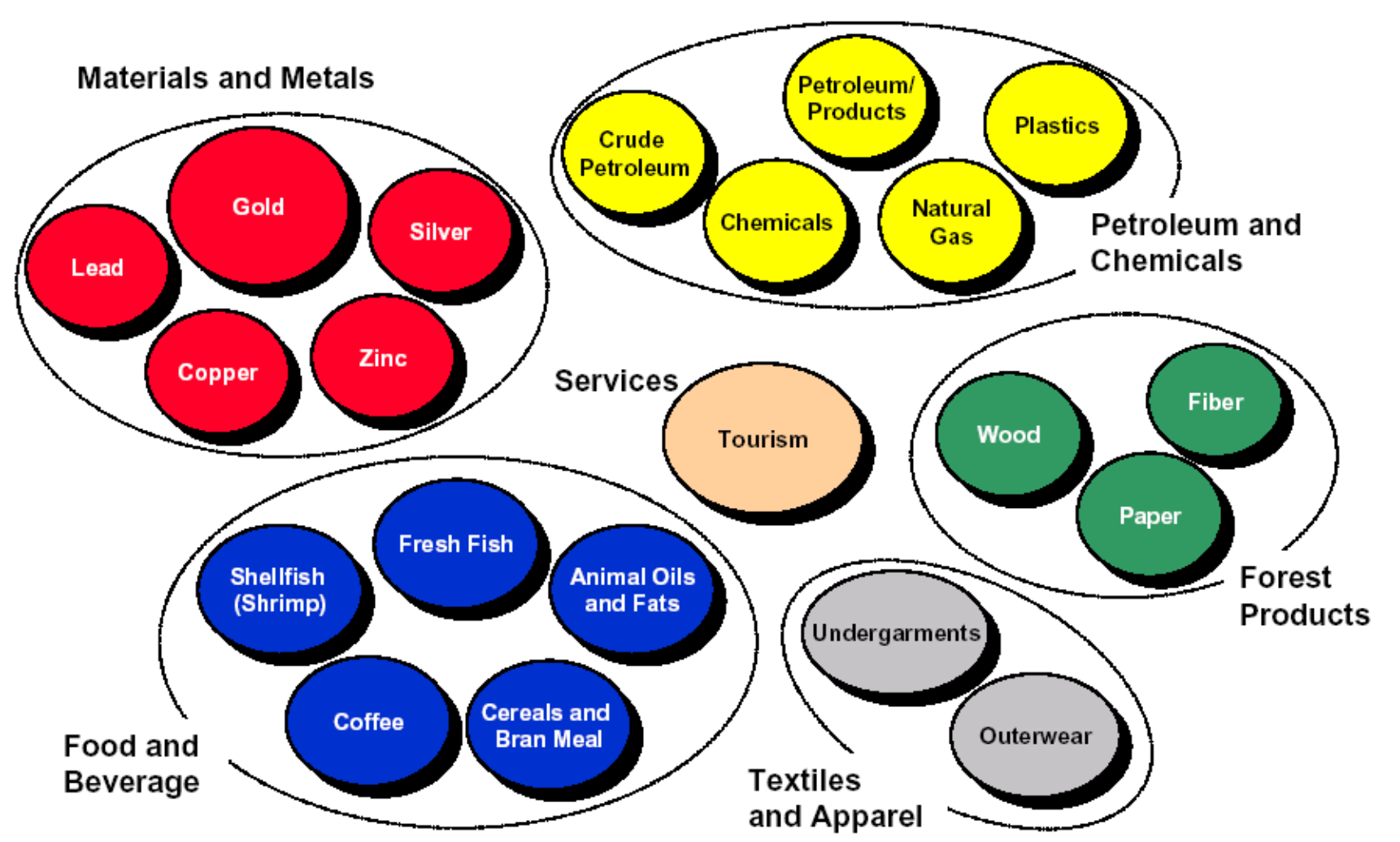
Peruvian Clusters
Cluster Development in Emerging Economies
Some Principles
- Improving the general business environment is essential, but cluster development is needed to attain middle-income levels
- Developing economies should upgrade traditional clusters including agriculture, never abandon them
- Recruitment of foreign direct investment should focus on existing and emerging clusters, not generalized appeals to locate in the country
- Incentives used to attract companies should be tailored toward training, infrastructure, and other areas that upgrade the clusters and create national assets versus the use of generalized subsidies and tax holidays
- Existing MNCs should be treated as nodes for cluster development
- The best way to retain companies is for them to be part of a cluster
- EPZs should be organized around clusters, with governing regulations designed to encourage linkages with the local economy
- A formal process for cluster development is an important component of economic development
- Private sector led
- Government convening and participation
- Seed funding for cluster assessment and the formation of cluster-based industry groups
Pre-Conditions for Cluster Development
1. A critical mass of locally-based companies or subsidiaries in the cluster who have met the market test
2. Some meaningful cluster-specific advantages in the diamond
- E.g., unique demand, specialized talent
3. The presence of a world class multinational company in the cluster with an important investment in the country/region and a commitment to upgrading it
4. Strength in a closely related cluster or clusters
→ Meeting at least two of these conditions is a basic requirement for success
- Distinguishing emerging clusters from wishful thinking
Government Impediments to Cluster Formation
- Tolerance of monopolies, cartels, protectionist regulations, and uncompetitive state-owned companies
- Rigidity in vocational training and university curricula making alignment with clusters difficult
- Regional development policies that artificially spread companies and corporate investment across geography to benefit depressed regions
- Incentives or requirements to locate in free zones or export processing zones that are isolated by regulations from the local economy
- In some countries the legacy of the Soviet planned economy model of development which works against cluster formation and positive externalities
The Mindset of Cluster Development
| Cluster Creation | Cluster Activation |
| Target areas of perceived market demand, rapid growth, important technology, or prestige Driven by public sector intervention Requires sustained financial commitment by the public sector Depends on public sector intervention High failure rate | Leverage existing assets, companies, history Build coalitions of private and public sector actors Requires sustained participation by all actors Transforms the roles of private and public sector Good success rate in making improvements in the local business environment |
Upgrading Microeconomic Competitiveness - A Two Pronged Apporoach
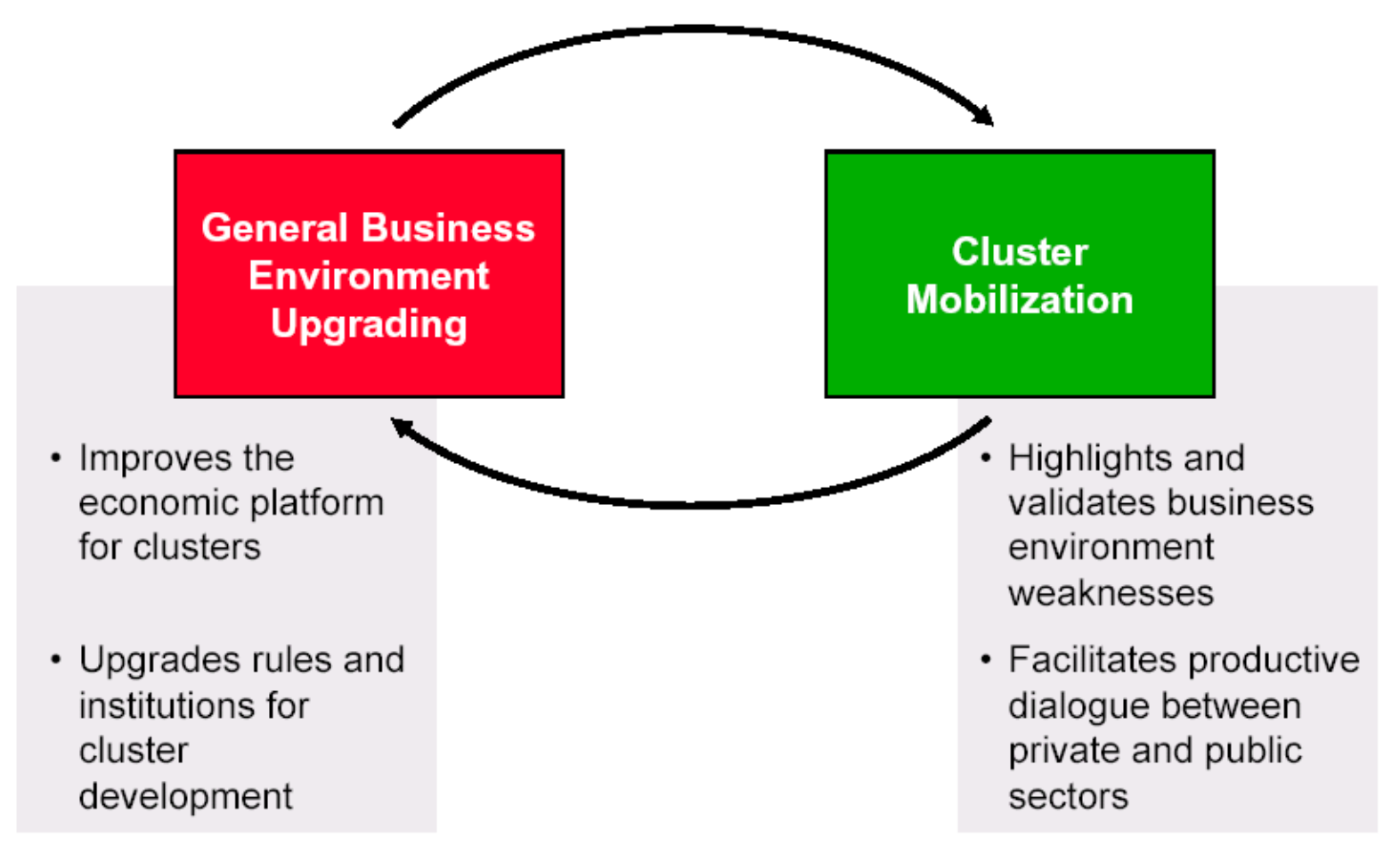
Cluster Activation (key activities)
1. Strengthening of cooperation among companies
- E.g., through joint activities in areas such as training, purchasing, quality standards, and export promotion
2. Improvements in the cluster business environment
- E.g., joint identification and improvement of barriers to productivity growth
3. Upgrading company operations
- E.g., identifying operational best practices and providing market intelligence
→ The appropriate mix of activities for a given cluster depends on the particular constraints to productivity growth
Cluster Policy versus Industrial Policy
| Industrial Policy | Cluster-based Policy |
| Target desirable industries / sectors Focus on domestic companies Intervene in competition (e.g., protection, industry promotion, subsidies) Centralize decisions at the national level Distort competition | All clusters can contribute to prosperity Domestic and foreign companies both enhance productivity Relax impediments and constraints to productivity Emphasize cross-industry linkages / complementarities Encourage initiatives at the state and local level Enhance competition |
Export Pocessing Zones, Cluster and Competitiveness
Developing economies have made extensive use of "Free Zones" or Export Processing Zones (EPZs) to attract foreign investment through tax incentives, import tariff exemptions, and dedicated infrastructure in a particular industrial park
- This approach limits lost tariff revenue by restricting exemptions to free zone companies
- Avoids the need for economy-wide reforms that may be politically difficult
EPZs are more successful if they are focused around clusters
- Firms will have common needs in infrastructure and skills
- Each company attracts similar companies as well as specialized suppliers and service providers
EPZ regulations should evolve over time to encourage linkages with the rest of the economy
- EPZs will have much less benefit to a country's competitiveness if they are isolated islands in the economy
EPZs must be seen as part of a process of driving overall improvements in rules, regulations, infrastructure, and government services, such as customs
- e.g., Expand zone advantages to other locations within the country over a 5-10 year period