Chapter 1
How to Measure Risk
Computing Historical Returns
The realized holding-period return on an asset can be written as
\[ R_t = \frac{P_t + D_t - P_{t-1}}{P_{t-1}} \]
where \(P_t\) is the end-of-period price and \(D_t\) is any cash distribution received during the period.
Two basic definitions used throughout the notes are:
\[ \text{Expected return} = \mathbb{E}[R_i], \qquad \text{Excess return} = R_i - r_f \]
Mean, Variance, and Standard Deviation
For a random return \(R_i\),
\[ \mu_i = \mathbb{E}[R_i] \]
\[ \sigma_i^2 = \mathbb{E}\big[(R_i - \mu_i)^2\big] \]
\[ \sigma_i = \sqrt{\sigma_i^2} \]
Sample Estimators
Given a sample of \(T\) realized returns,
\[ \hat{\mu}_i = \frac{1}{T}\sum_{t=1}^{T}R_{i,t} \]
\[ \hat{\sigma}_i^2 = \frac{1}{T-1}\sum_{t=1}^{T}(R_{i,t} - \hat{\mu}_i)^2 \]
If the realized returns are far from their sample mean, the variance is high; in practical terms, the asset is riskier than an investment with a lower variance.
Median
- The median is the 50th percentile, so there is probability one-half that \(R\) lies below it.
- Skewness
- Skewness captures asymmetry in the return distribution.
- Negative skewness means large losses are more likely than large gains.
- Positive skewness means large gains are more likely than large losses.
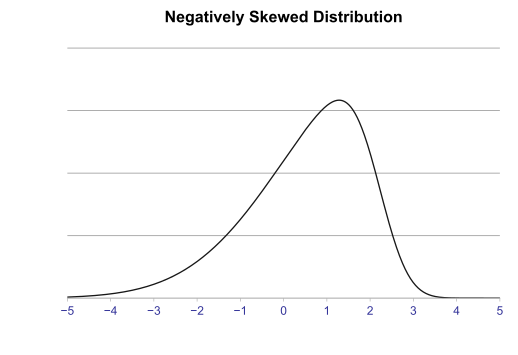
Illustrative negatively skewed probability distribution.
Correlation
Correlation asks how closely two random variables move together:
\[ \operatorname{Cov}(R_i,R_j) = \mathbb{E}\big[(R_i-\mu_i)(R_j-\mu_j)\big] \]
\[ \operatorname{Corr}(R_i,R_j) = \frac{\operatorname{Cov}(R_i,R_j)}{\sigma_i \sigma_j} \]
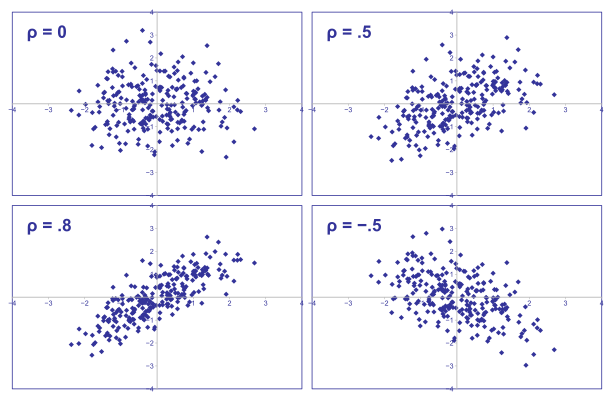
Illustrative samples with the stated correlations; not empirical stock-return data.