A default-free bond has five years to maturity, €1,000 face value and a 5% annual coupon. Its current price is €1,000.
- A.What is its current yield to maturity?
- B.What happens if the yield rises to 5.20%?
A default-free bond has five years to maturity, €1,000 face value and a 5% annual coupon. Its current price is €1,000.
5% annually.
At par, the yield equals the coupon rate when both use the same payment-frequency convention.
New price = €991.39
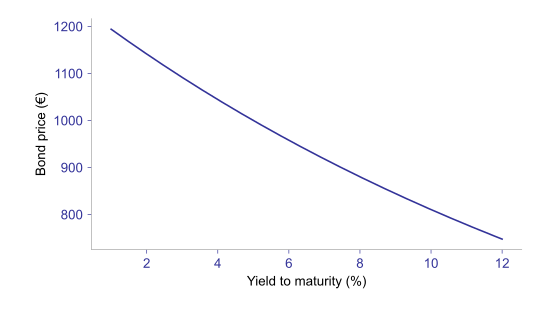
Price falls when the discount rate rises, holding promised cash flows unchanged.
A ten-year bond has face value €1,000 and annual coupon rate 4.875% (annual coupon €48.75).
At 4.00%: €1,070.97.
At 5.00%: €990.35.
At 10.00%: €685.09.
Face value is 1,000; maturity is 30 years; annual coupon rate is 7.000% and quoted annual YTM is 6.500%. Coupons are annual.
Price = 1,065.29.
New price = 1,012.53.
Both prices fall. The longer-maturity bond normally has greater duration and therefore the greater percentage price decline, for the same initial yield and otherwise comparable terms. Interpret the dated maturities relative to the historical exercise date, not today.
Neither face value changes. Face value is contractual. The fixed-rate bond’s market price normally rises; a floater’s market price stays close to par at a reset if its reference rate and required discount margin remain aligned. Face value and market value are distinct.
A flat market yield curve unexpectedly shifts from 2% to 3%. Discuss the effects, holding expected contractual cash flows and credit risk constant.
Its price falls: future fixed payments are discounted at higher yields.
Its exposure is negligible because only one day remains; original maturity does not determine current interest-rate risk.
It generally stays close to par when coupons reset promptly to the new reference rate. A finite reset delay, spread change or cap can still change its value.
There should be no additional unexpected price jump solely when the anticipated event occurs. The yield curve and prior prices already reflect expectations.
Higher required discount rates reduce value if expected cash flows and risk premiums are unchanged. A macroeconomic shock can also change those variables, so the unconditional equity-price response is not determined.
Discuss interest-rate risk and bond definitions.
For positive fixed payments the price falls, but a zero has the greatest duration at the same maturity and yield, so it is more, not less, sensitive to a small yield change.
Generally true holding coupon, yield and other terms comparable. Duration is the precise local sensitivity measure; maturity alone is insufficient across arbitrary bonds.
False. Coupon rate is contractual annual coupon divided by face. YTM incorporates price, coupons and redemption, subject to its reinvestment interpretation.
False for an ordinary floater: the coupon resets, while face value stays fixed.
Usually false near reset with unchanged credit spread: future coupons fall too, keeping price near par. Reset lag, caps and spread changes can create sensitivity.
On 21 January 2020, Molvania’s fixed-rate yield curve is flat at 2% and Euribor is 1%. All bonds have face 100 and were issued at par: A issued today, coupon 2%, matures 21 January 2021; B issued 21 January 2018, coupon 4%, matures 21 January 2025; C issued today, coupon Euribor + 1%, matures 21 January 2025. Assume annual payments and an unchanged credit spread.
A and B were issued at different dates with different prevailing required yields. C’s spread can compensate for sovereign credit, liquidity and other risks relative to the reference rate.
A and B both require 2% under the stated flat curve; B trades above par. C’s current reference-plus-spread rate is 2%. A unique realised yield to maturity on a floater is not fixed today because future Euribor is unknown; 2% is a flat-forward projection, not a guaranteed lifetime yield.
A and B fall. C stays approximately at par if its coupon resets immediately and the required spread stays unchanged; a reset lag creates some price exposure. B has the largest percentage decline, A next, and C the smallest under those assumptions. B has five years remaining versus A’s one.