| Project | Year 0 | Year 1 | Year 2 | Year 3 |
|---|---|---|---|---|
| A | -1000 | 400 | 600 | 800 |
| B | -1500 | 500 | 700 | 1000 |
The required return is 10%.
- A.Calculate the NPVs and select the project.
| Project | Year 0 | Year 1 | Year 2 | Year 3 |
|---|---|---|---|---|
| A | -1000 | 400 | 600 | 800 |
| B | -1500 | 500 | 700 | 1000 |
The required return is 10%.
Discount each future cash flow at 10% for its own maturity. The initial investment at time 0 is not discounted.
Choose A: it has the higher NPV.
Both NPVs are positive. Because the projects are mutually exclusive, select the one that creates more value.
Project A requires €10,000 now and pays €20,000 in one year. Project B requires €20,000 now and pays €35,000 in one year. The projects are mutually exclusive, have the same risk and face a 10% discount rate; financing is available.
| Project | IRR | NPV (€) |
|---|---|---|
| A | 100% | 8,181.82 |
| B | 75% | 11,818.18 |
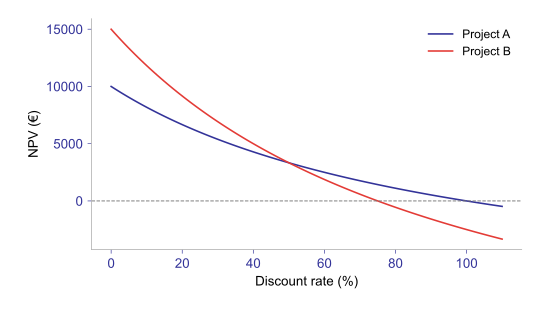
Choose B: it creates more value in euros despite the lower percentage return. The incremental investment B − A costs €10,000 and returns €15,000; its 50% IRR exceeds the 10% hurdle rate.
Alfa requires €50,000 today and returns €60,000 next year. B requires €10,000 and returns €15,000 next year. The required return is 10%.
| Project | NPV | IRR |
|---|---|---|
| Alfa | 4,545.45 | 20% |
| B | 3,636.36 | 50% |
For mutually exclusive projects without capital rationing, choose Alfa: it adds more value. B has the greater percentage return.
Alfa and Beta are mutually exclusive, have equal lives and comparable risk. Alfa costs €20 and Beta €200. Assume funding is available.
| Project | NPV | PI | IRR |
|---|---|---|---|
| Alfa | 16 | 1.80 | 41.04% |
| Beta | 52 | 1.26 | 22.11% |
Choose Beta: €36 more value.
The higher PI and IRR of Alfa do not override the greater absolute NPV when projects are mutually exclusive and capital is not rationed.
Choose the higher positive NPV when the projects are mutually exclusive, risks are valued appropriately and financing is available. For independent projects, both may be accepted if both have positive NPV. With capital rationing or different constraints, the optimal combination can differ. If both NPVs are negative and neither is mandatory, reject both.